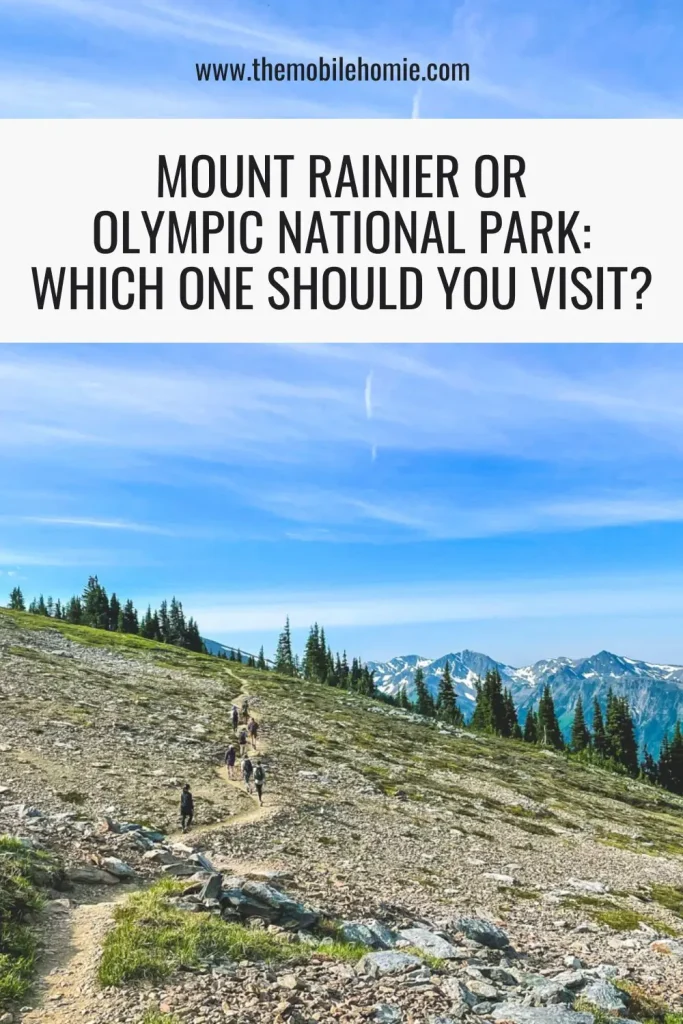
Mount Rainier or Olympic National Park: Which One Should You Visit?

The Mobile Homie contains affiliate links and is a participant in the Amazon Services LLC Associates Program, as well as other affiliate programs. If you click on a link or make a purchase through one of these links, we may earn a small commission at no extra cost to you. For more details, see our Privacy Policy.
Washington State presents you with a difficult choice: two of the country’s most stunning national parks, both within a few hours of Seattle, yet most visitors have time for only one on their Pacific Northwest trip.
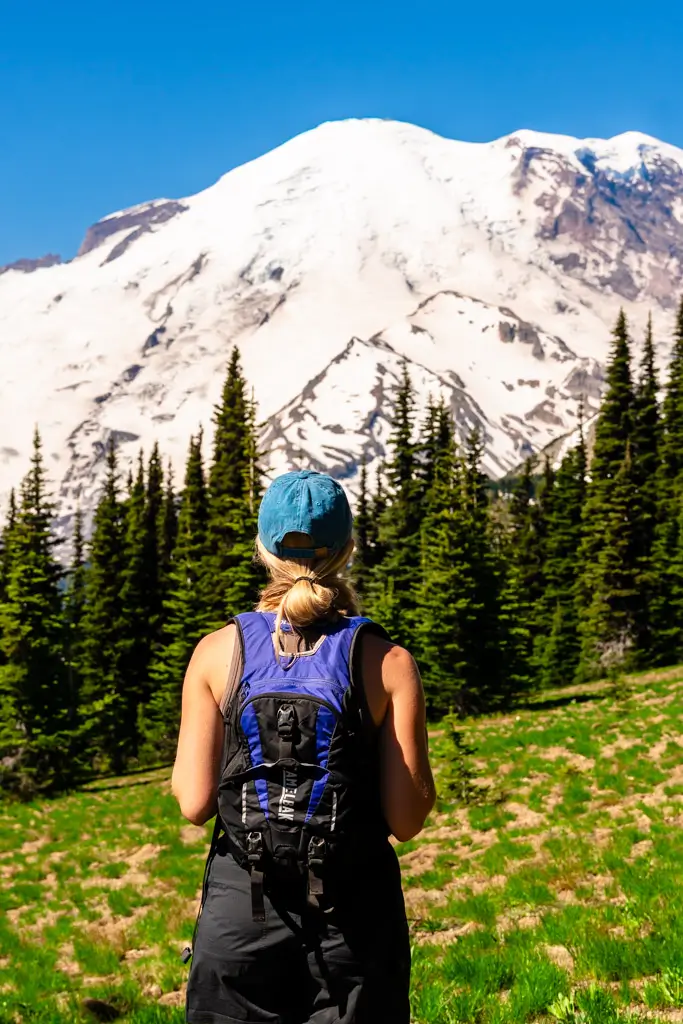
Mount Rainier looms 14,410 feet above the South Sound, with glaciers and wildflower meadows, while Olympic National Park, on its own peninsula, packs rainforest, glacier-carved lakes, and 70-plus miles of wild Pacific coastline into a single park.
We’ve made multiple trips to both, chasing sunrise at Sunrise and wildflowers at Paradise on Mount Rainier, then a separate long weekend working through Lake Crescent, the Hoh Rain Forest, and Rialto Beach at Olympic.
If you’re weighing Mount Rainier vs Olympic National Park for your next Washington trip, here’s an honest, head-to-head breakdown of their similarities, differences, hikes, and distance from Seattle, all to help you figure out which National Park visit is best for your travel style, based on our experience.
Mount Rainier vs Olympic National Park: Quick Answer
Mount Rainier is the better choice for a shorter trip centered on one iconic, postcard-perfect volcano, with alpine meadows, glacier views, and well-developed trails within a 2 to 2.5-hour drive of Seattle.
Olympic National Park is the better choice if variety matters more than convenience, as it is home to rainforest, mountains, and coastline, all in one park. However, it’s farther from Seattle (3 to 4 hours) and really needs at least three days to see properly.
If you only have a single day, Rainier is the best choice. However, we recommend at least a 2-day Mt. Rainier itinerary to get the best Park experience.
If you have a long weekend or more, Olympic offers you a wider range of experiences.
| Aspect | Mount Rainier | Olympic National Park |
|---|---|---|
| Size | ~236,000 acres | ~922,651 acres |
| Distance from Seattle | ~2–2.5 hours | ~3–4 hours (or via ferry) |
| Entrance fee | $30/vehicle (7 days) | $30/vehicle (7 days) |
| Yearly Visitors | 2.41 million (2025) | 3.58 million (2025) |
| Established | 1899 | 1938 |
| Signature feature | A single 14,410-ft volcano with alpine meadows and glaciers | Three ecosystems—rainforest, mountains, and coast—in one park |
| Best for | First-timers seeking an iconic, accessible volcano experience | Travelers seeking variety and willing to drive more |
| Ideal trip length | 1–2 days | 3+ days |
Olympic National Park vs Mount Rainier: Similarities and Differences
Similarities
Before getting into what sets them apart, it’s worth noting how much these two parks have in common:
- Both are excellent for hiking and offer a range of trail difficulties.
- Both are in Washington State and are reachable as day trips or weekend trips from Seattle.
- Both require either a standard park entrance pass ($30/vehicle for 7 days) or the America the Beautiful annual pass ($80), which covers entrance fees at all national parks for the year.
- Neither has gas stations inside the park boundary, so make sure to fill up before you go in.
- Both have unreliable cell service in most areas, so download offline maps (AllTrails or Google Maps) before you leave home.
- Both parks have legendary, rapidly changing mountain weather. Even sunny summer mornings can turn into a cold, wet afternoon at either park, so pack accordingly.
- Both peak with wildflowers in July and August and see their parking lots fill before 9 AM on summer weekends.
- They pair well together; if you have a full week, you can do both as part of a 7-day Pacific Northwest road trip that also includes the Oregon Coast and the Columbia River Gorge.
Differences
The biggest difference comes down to focus.
Mount Rainier offers one overwhelming subject: the mountain itself, seen from two very different angles, depending on whether you’re at Sunrise or Paradise.
Olympic doesn’t have a singular subject; instead, it asks you to cover ground across three unrelated ecosystems that happen to share a park boundary.
| Aspect | Mount Rainier | Olympic National Park |
|---|---|---|
| Terrain | Alpine/subalpine meadows and glaciers around one volcano | Temperate rainforest, glacial lakes, and Pacific coastline |
| Driving within the park | Minimal once you’re at Paradise or Sunrise | Significant—areas can be 1.5+ hours apart |
| Crowds | Heavy at Paradise, moderate at Sunrise | Spread out across a much larger park |
| Access | Paradise is open year-round; Sunrise only July–September | Open year-round, though some roads close seasonally |
| Wildlife | Mountain goats, marmots, pikas | Roosevelt elk, black bears, bald eagles, and mountain goats |
| Precipitation | Rainfall throughout the year but generally drier | Significantly wetter, as much of the park is temperate rainforest, receiving up to 140 inches of rain annually in areas like the Hoh |
| Activities | Mountaineering, snowshoeing, and skiing are popular | Wildlife viewing, tide pooling, beach combing, and swimming |
| Vibe | Concentrated, dramatic, postcard-iconic | Diverse, exploratory, “three parks in one” |
Best Hikes at Each Park
If you’re chasing big views, both parks deliver, just in very different ways.
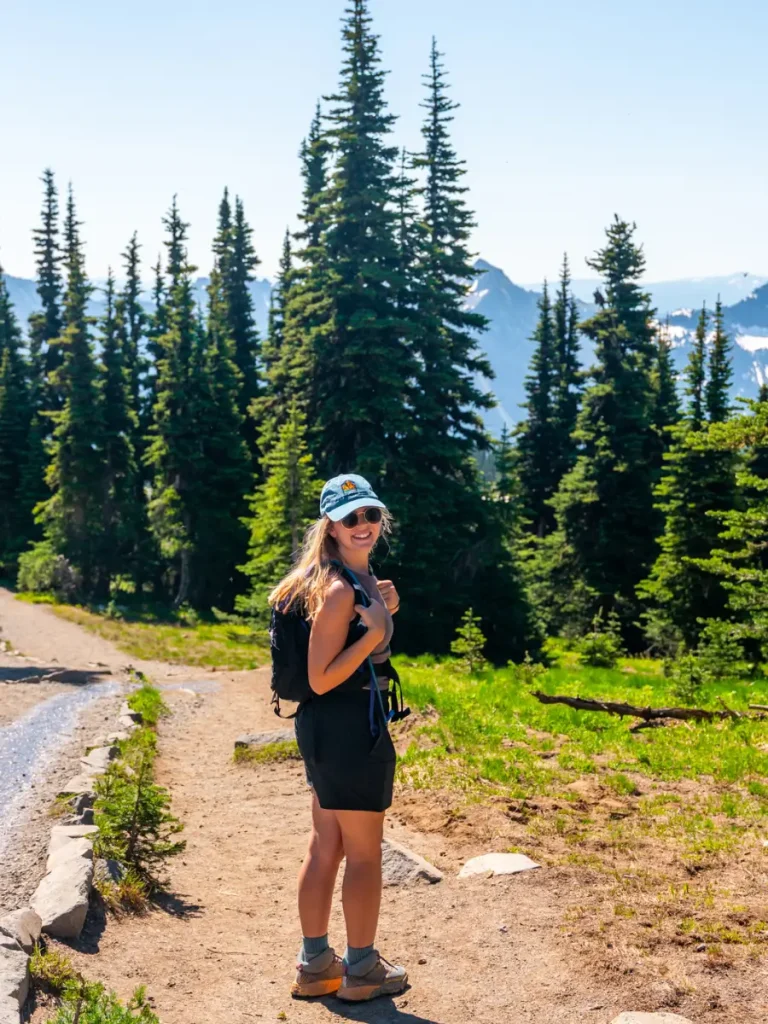
At Mount Rainier, hiking splits into two corridors: Sunrise offers high-elevation lookout points and sweeping Cascade views, while Paradise puts you right at the base of the wildflower meadows that lead up the mountain.
If you want a detailed breakdown of those two areas, check out our Sunrise vs. Paradise guide.
Olympic flips the script. Instead of choosing between two corridors on the same mountain, you’re choosing among three distinct ecosystems—the lake, the rainforest, and the coast—each with its own trail system.
Plan to pick one region per day rather than trying to combine them; the drive times between areas make that tough in a single outing.
Below, we’ve compiled a few of the best hikes from Mount Rainier National Park and Olympic National Park, organized by difficulty level, based on our time on the trails.
Top Mount Rainier Trails
- Sunrise Rim Trail (Sunrise)
- 1.5 miles, 300 ft gain, easy
- A great introduction with panoramic views and minimal elevation gain.
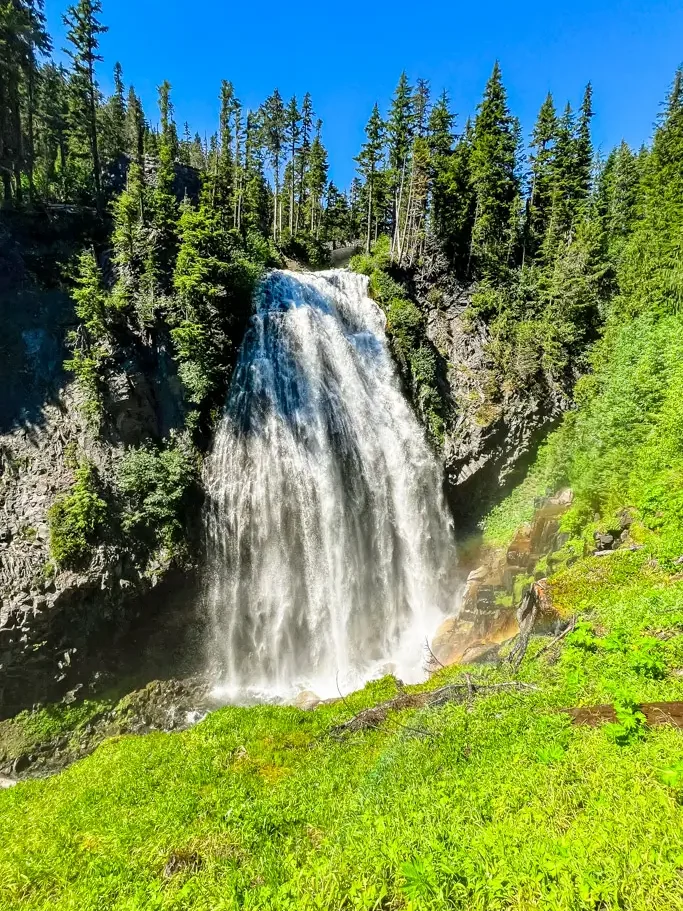
- Myrtle Falls Trail (Paradise)
- 0.8 miles, 100 ft gain, easy
- A paved, family-friendly walk to a waterfall framed by the mountain.
- Mount Fremont Lookout (Sunrise)
- 5.6 miles, 900 ft gain, moderate
- Climbs through wildflower meadows to a historic fire lookout with 360-degree Cascade views.
- Skyline Trail (Paradise)
- 5.5 miles, 1,700 ft gain, moderate
- The signature Rainier hike: wildflower meadows, glacier views, and Panorama Point, where you can see Mount Adams, St. Helens, and Hood on a clear day.
- Burroughs Mountain Trail (Sunrise)
- 7+ miles, 1,200 ft gain, strenuous
- This trail takes you onto the actual slopes of Rainier with close-up glacier views.
Top Olympic National Park Trails
- Hall of Mosses (Hoh Rain Forest)
- 1.1-mile loop, ~80 ft gain, easy
- The park’s most photographed trail, beneath ancient, moss-draped bigleaf maples.
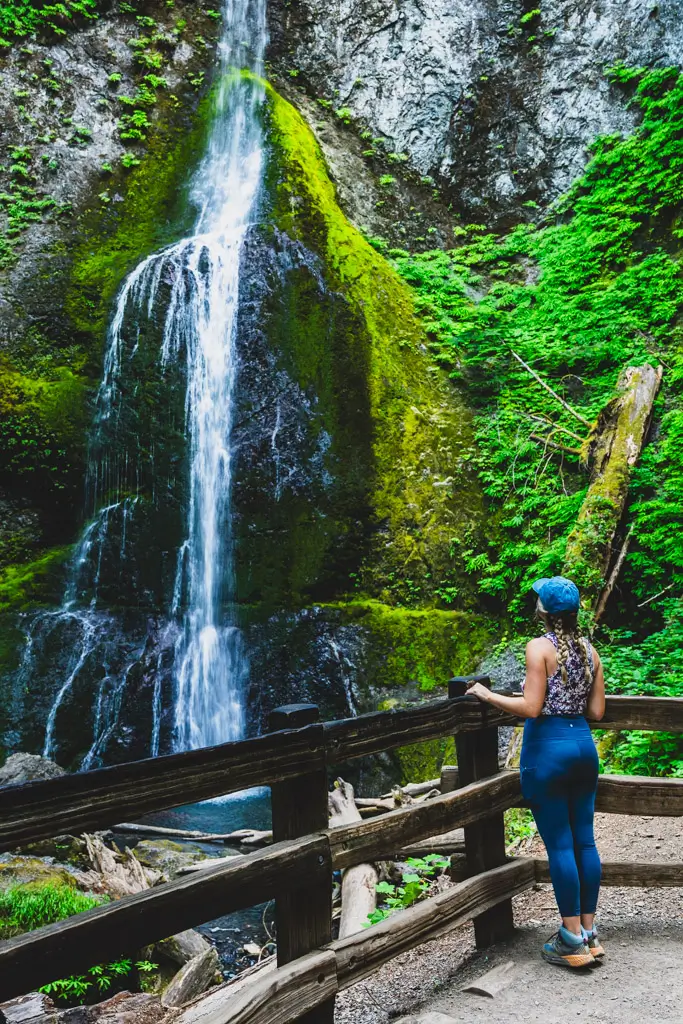
- Marymere Falls Trail (Lake Crescent)
- 1.8 miles, ~300 ft gain, easy
- Leads to the tallest waterfall in the park at 90 feet.
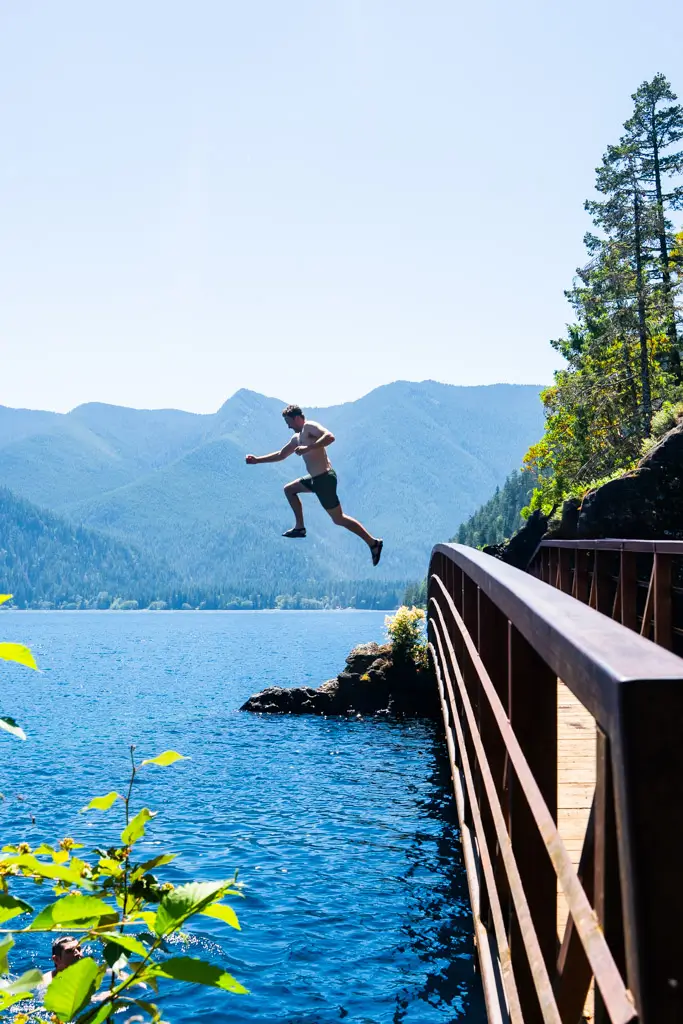
- Spruce Railroad Trail to Devil’s Punchbowl (Lake Crescent)
- 2.4 miles, ~130 ft gain, easy
- Flat lakeside trail ending at a clear, teal-blue swimming spot.
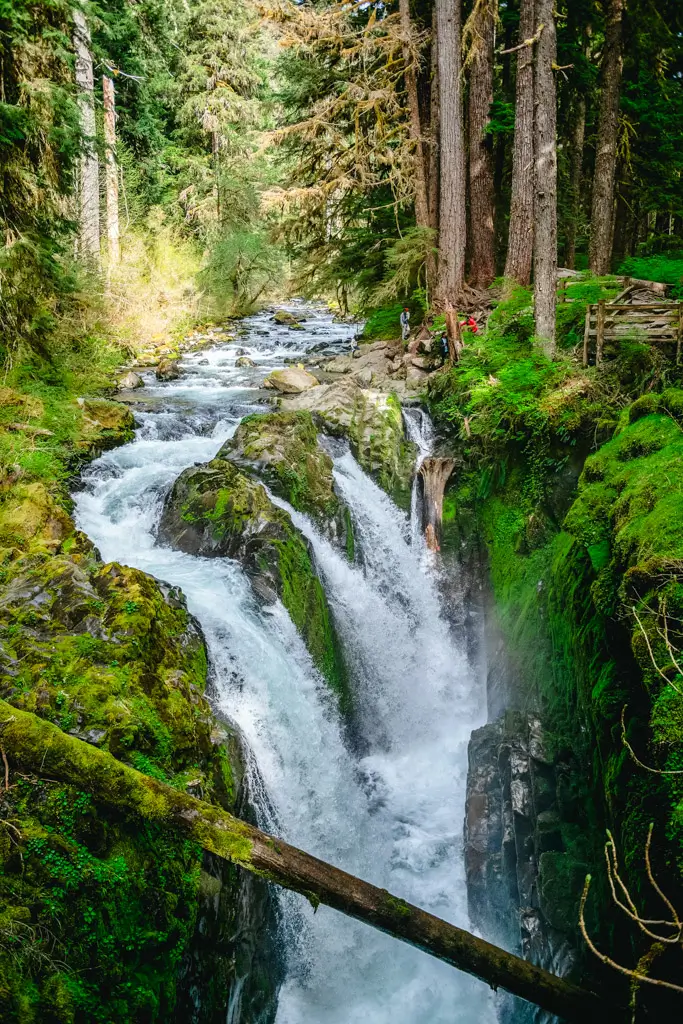
- Sol Duc Falls
- 1.8 miles, ~250 ft gain, easy
- One of the most unique waterfalls in the park, where the river splits into three or four chutes at once.
- Hole-in-the-Wall (Rialto Beach)
- ~3 miles round trip, easy-moderate.
- A tide-dependent beach walk to a rock arch carved through the headland.
Edge: Rainier’s trails are more concentrated and easier to string together in a single day. Olympic’s trails are spread across the park, so you’ll generally choose one ecosystem per day rather than combining several.
Distance from Seattle
- Mount Rainier (Sunrise): About 100 miles, roughly 2 to 2.25 hours via SR-410 E through Enumclaw.
- Mount Rainier (Paradise): About 106–116 miles, roughly 2.5 hours via I-5, WA-410 E, and WA-167 S.
- Olympic National Park (Lake Crescent): About 3 to 4 hours, either driving around the south end of Puget Sound or taking the Washington State Ferry to Bainbridge Island and then driving north through Port Angeles (often more scenic, sometimes faster depending on ferry timing).
Edge: Mount Rainier, by a solid margin. It’s the easier choice for a single-day trip or a quick overnight because it’s much closer, especially if you’re tacking it onto a longer Seattle itinerary.
Accommodations Near These National Parks
Where to Stay Near Mount Rainier
- Ashford / Packwood — Closest towns outside the Nisqually entrance, with cabins, motels, and rentals.
- Paradise Inn — Historic lodge right at the visitor center (5,420 ft). Open mid-May through early October; books up months in advance, but it’s truly fantastic if you can snag a reservation.
- National Park Inn (Longmire) — This classic lodge is open year-round, offers on-site dining, and provides easy access to trails, as it’s about 20 minutes from Paradise.
- Cougar Rock Campground — About 10 miles from Paradise, open May–October, with 173 reservable sites, flush toilets, potable water, and fire rings.
- White River Campground (near Sunrise) — 112 sites, first-come, first-served, open July–September.
Campsite reservations open 6 months in advance, and they go very fast! Book ASAP!
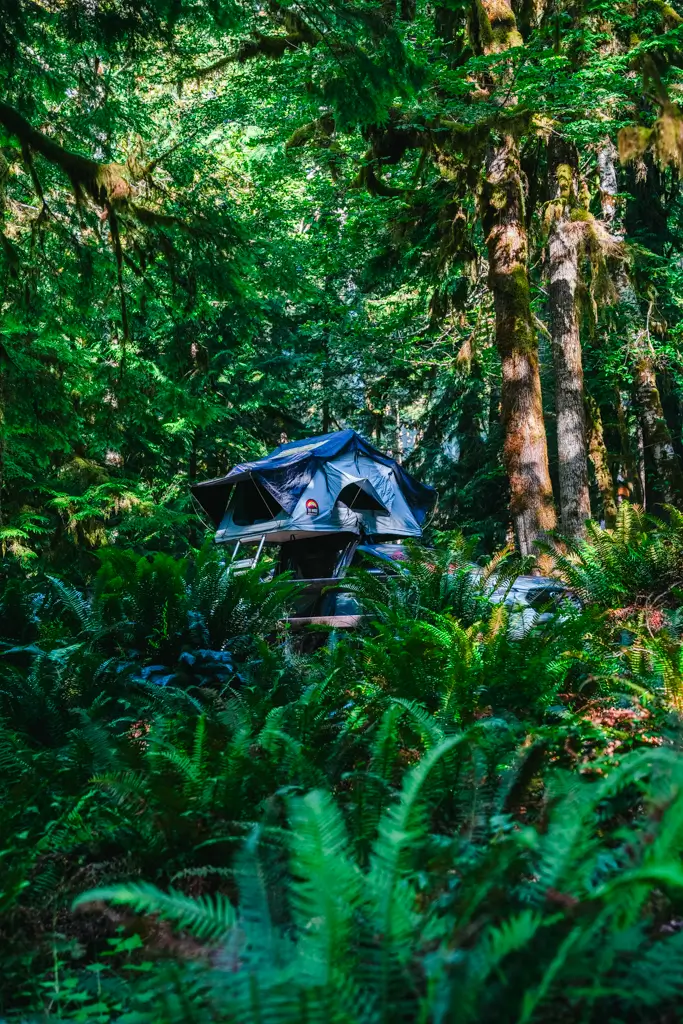
Alternatively, if you’re comfortable roughing it, National Forest camping just outside the park is free at many spots, though there are no facilities.
Where to Stay Near Olympic National Park
- Budget:
- Kalaloch Campground — Oceanfront sites right on the coast; books up fast in summer.
- Fairholme Campground — Nestled along the western end of Lake Crescent. First-come, first-served camping from April 25 to May 14. Reservations required May 15 through September 29, 2026.
- Mora Campground — National Park Service campground located about a mile from Rialto Beach.
- Mid-range:
- Lake Crescent Lodge — Historic 1916 lodge directly on the lake; reserve early for summer.
- Log Cabin Resort — More casual option on the lake’s north shore, featuring cabins, glamping, and campsites.
- Luxury:
- Sol Duc Hot Springs Resort — Upscale cabins with access to natural hot spring pools.
- La Push / Quileute Oceanside Resort — Right on the coast, operated by the Quileute Tribe. Cabins and rooms with ocean views, just steps from First Beach. Book well in advance.
Forks / Port Angeles — Practical home bases with more restaurants and lodging options if you’d rather not camp.
What to Pack (For Either Park)
The packing list barely changes between the two because Pacific Northwest mountain weather is consistently unpredictable:
- Your National Park Pass or entrance fee at the gate
- Waterproof jacket with a hood (yes, even in July, especially since both regularly get precipitation)
- Layers—temperatures can swing by 30+ degrees from morning to afternoon
- Sturdy, broken-in hiking boots, since you don’t want to be ‘trying out’ a new pair here
- Daypack for hikes, so your hands are free for photos and safety
- First-aid kit for blisters or other mishaps that may occur on the trail
- Plenty of water, your own snacks (food options are limited at both parks), and a reusable water bottle
- Sunscreen as UV exposure is stronger at higher elevations
- Offline maps downloaded in advance, plus a paper map as a backup
- Portable phone charger and a cable to go with it
For a more comprehensive list, see our Pacific Northwest packing guide.
Olympic National Park vs Mount Rainier vs North Cascades
If you’re trying to choose among all three of Washington’s mainland national parks, here’s how they stack up:
| Olympic NP | Mount Rainier NP | North Cascades NP | |
|---|---|---|---|
| Size | ~922,651 acres | ~236,000 acres | 504,781 acres |
| Distance from Seattle | ~3 hours | ~2–2.5 hours | ~2–2.5 hours |
| Entrance fee | $30/vehicle (7 days) | $30/vehicle (7 days) | None |
| Established | 1938 | 1899 | 1968 |
| Signature feature | Rainforest, coast, and mountains in one park | A single iconic, accessible volcano | More glaciers than any other park in the lower 48 |
| Best for | First-timers wanting variety in one trip | First-timers wanting an iconic, easy-access mountain | Serious hikers wanting solitude and rugged terrain |
The short version: Mount Rainier is the easiest and most iconic first stop.
Olympic offers the most variety for a multi-day trip.
North Cascades is the pick if you want fewer crowds and more rugged, off-the-beaten-path terrain. It’s also free to enter and draws a fraction of the visitors of the other two.
Final Verdict: Mount Rainier vs Olympic National Park—Which Should You Visit?
Choose Mount Rainier if:
- You have only one day or a weekend
- You want an unforgettable, photogenic mountain view with minimal driving
- You’re traveling with kids or less experienced hikers (especially via Paradise)
- You want the option of year-round access
Choose Olympic National Park if:
- You have three or more days to spread out across the park
- Variety matters more to you than convenience
- You want rainforest, mountains, and coastline in a single trip
- You don’t mind the extra drive time (or you want to take the ferry)
If you have a full week: Do both. Pair Mount Rainier and Olympic National Park as part of a longer Pacific Northwest loop—Seattle, Rainier, Portland, the Oregon Coast, and Olympic on the way back. It’s exactly the kind of trip that makes the most of what this corner of the country offers.
FAQs
Mount Rainier vs Olympic National Park: Which Is Better?
Neither is objectively “better” because it depends on your trip’s goals.
Mount Rainier wins for a short trip centered on a single dramatic, accessible view of a volcano.
Olympic National Park wins if you want more variety, as it offers rainforest, mountains, and coastline. However, you’ll need at least three days to explore it.
Which is closer to Seattle, Mount Rainier or Olympic National Park?
Mount Rainier is closer, about 2 to 2.5 hours, depending on whether you’re headed to Paradise or Sunrise.
Olympic National Park takes 3 to 4 hours, depending on your route and ferry schedule.
How many days do you need at Mount Rainier vs Olympic National Park?
Mount Rainier needs a focused 1–2-day visit because most of what you came for (Paradise or Sunrise) is concentrated in one area.
Olympic needs at least 3 days to properly cover its three main regions—Lake Crescent, the Hoh Rain Forest, and the coast—without feeling rushed.
Can you visit both Mount Rainier and Olympic National Park in one trip?
Yes. They’re often combined as part of a longer Pacific Northwest road trip, with Seattle as a natural midpoint.
Plan on roughly 2.5 hours to reach Rainier and another 3–4 hours to reach Olympic from there (or from Seattle).
Is Mount Rainier near Olympic National Park?
Not exactly. They’re both in Washington State but on opposite sides of the Seattle metro area, which makes them feel farther apart than the distance suggests.
Mount Rainier is southeast of Seattle (roughly 2–2.5 hours away), while Olympic National Park is northwest of Seattle on the Olympic Peninsula (roughly 3–4 hours away).
Driving directly between the two parks without stopping in Seattle takes about 4.5–5 hours, depending on your route and ferry timing.
Most visitors use Seattle as a natural midpoint, splitting their time across separate trips or building it into a longer Pacific Northwest road trip.
Which Park Is Better To Visit In The Summer?
Both parks peak in summer, but in different ways.
At Mount Rainier, summer (July–September) is the only window when Sunrise is accessible by car, and it’s when the wildflower meadows at both Sunrise and Paradise are at their most spectacular (typically mid-July through early August).
However, parking can fill by 9 AM on summer weekends, and crowds can be heavy.
At Olympic, summer brings sunny days, temperatures in the 60s and 70s, open roads, and fully accessible ecosystems.
Crowds are more spread out simply because the park is so much larger.
If wildflowers and alpine views are your priority, Rainier in summer is hard to beat.
If you want variety without feeling like you’re sharing a trail with hundreds of other people, Olympic’s size works in your favor.