
What to Buy at European Christmas Markets (And What to Skip) for First-Time Visitors

The Mobile Homie contains affiliate links and is a participant in the Amazon Services LLC Associates Program, as well as other affiliate programs. If you click on a link or make a purchase through one of these links, we may earn a small commission at no extra cost to you. For more details, see our Privacy Policy.
JT and I spent December 2024 hopping from city to city — Budapest, Bratislava, Vienna, Tallinn, Riga, Wrocław, and Prague — and by the time we reached market number six, we started noticing the same wooden ornaments and the same “handmade” ceramics turning up in cities hundreds of miles apart.
That’s not a reason to skip shopping, but it is a reason to research what to buy at European Christmas markets in advance, especially if you’re a first-timer.
We came home with things we genuinely love and still use every December. But that’s because we gained insight from all those markets that we wouldn’t have had if we’d visited only one.
So this isn’t just a list of Christmas market souvenirs for sale. It’s what’s actually worth your money, how to tell the real thing from the imported stuff, what we’d skip entirely (so you don’t head home with something mass-produced in a factory), and the one souvenir you should never pay extra for.
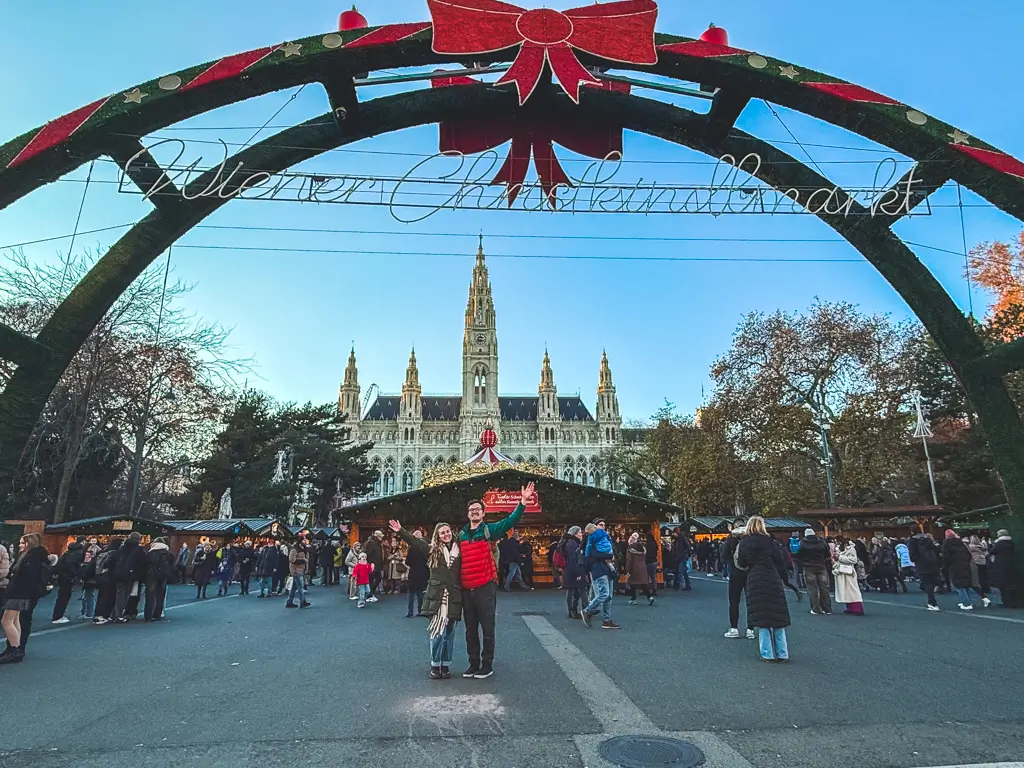
How to Tell Which Christmas Market Gifts Are Handmade
Nearly every market we visited in Central Europe and the Baltics has two types of craft stalls sitting right next to each other, and they look almost identical at first glance.
One is a local artisan selling work they created.
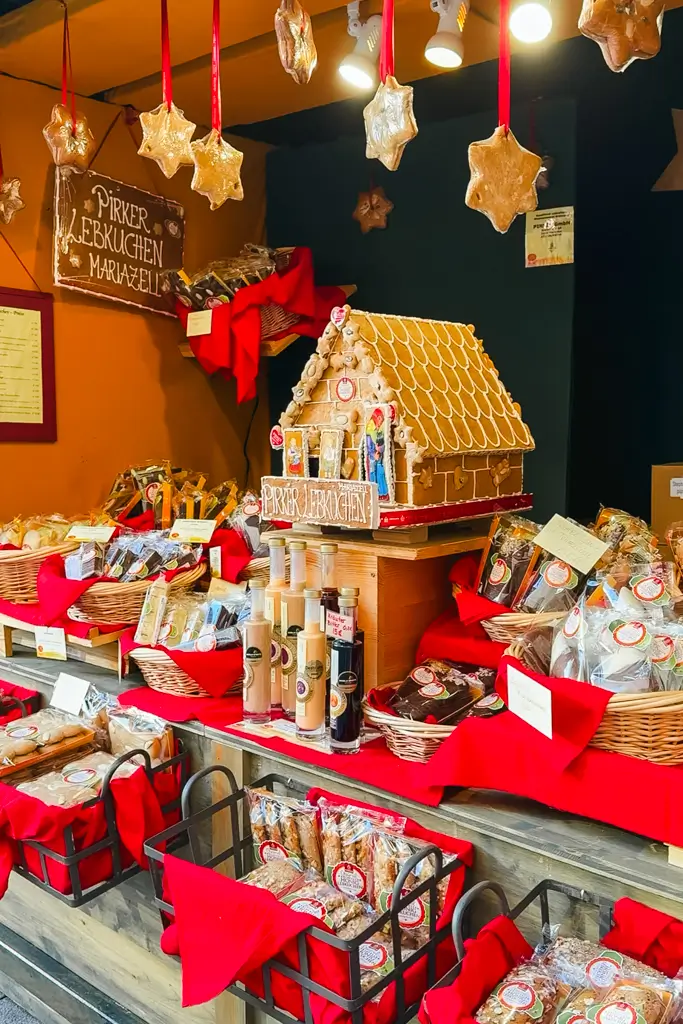
Stephansplatz Christmas Market
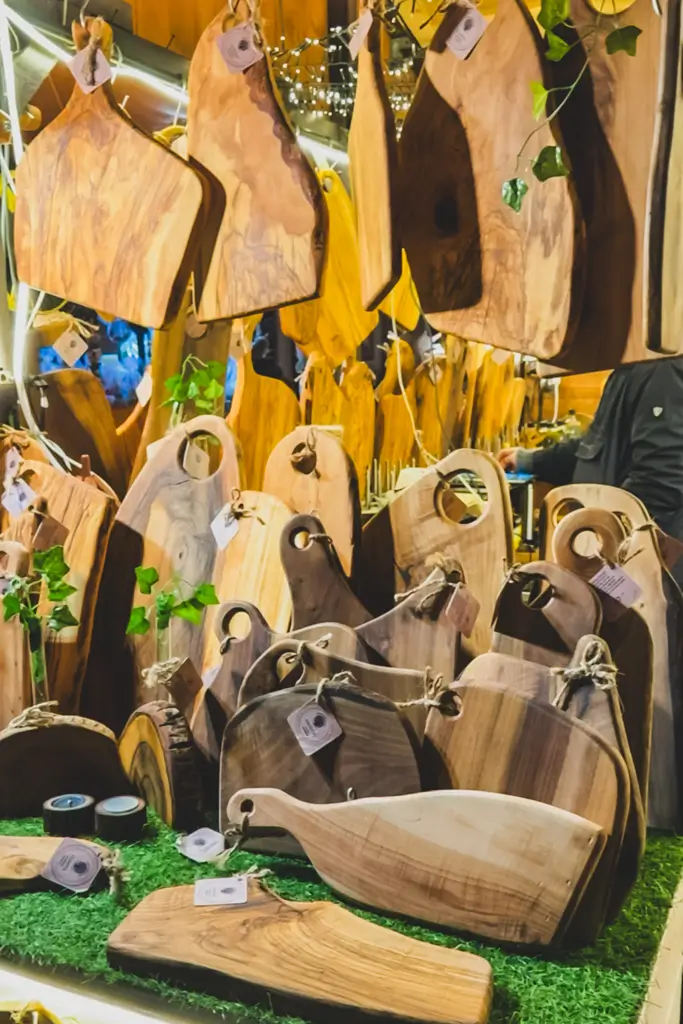
The other is a vendor who travels the market circuit, reselling wholesale goods.
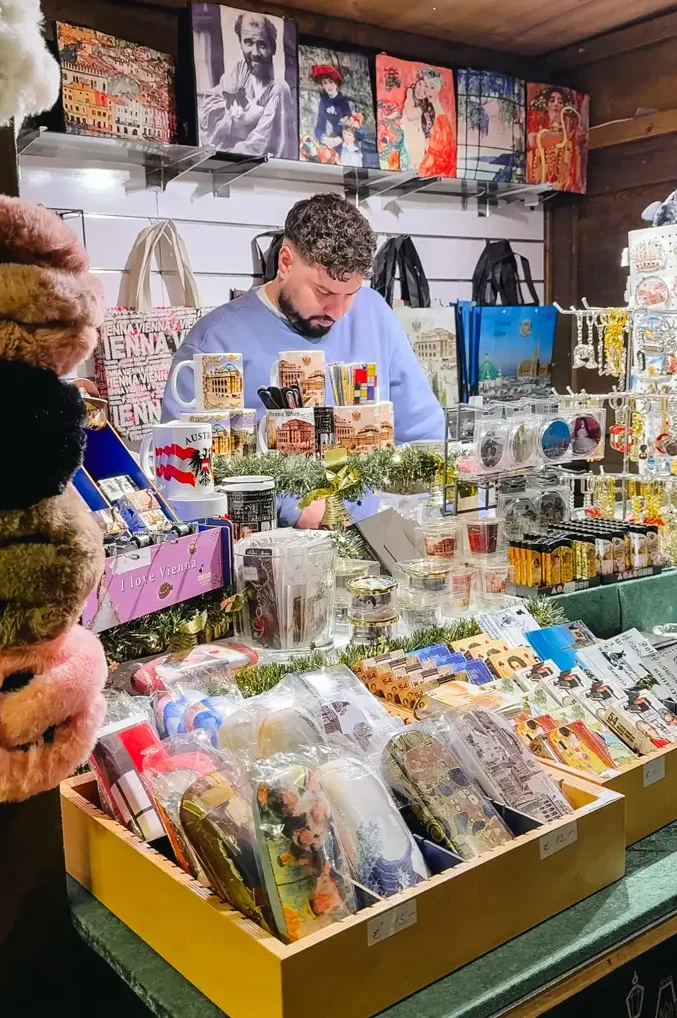
Both have wooden stalls. Both have warm lighting. Both may have a sign that says handcrafted.
Here’s what we learned to look for.
Watch for someone actually working. This is the most reliable tell by far.
At Belvedere, one of Vienna’s Christmas markets, we spent ages talking with a glassblower who demonstrated his technique at his stall and explained the methods his family had passed down.
At one of the Bratislava Christmas markets, we watched a woodcarver at his booth.
Those aren’t stalls where you wonder whether it’s real while you’re watching it happen in real time.
Look at the uniformity. Machine-knitted pieces have perfectly even stitches throughout. Hand-knitted ones have slight variations and cost more because they should.
The same logic applies to painted ceramics—hand-painted pieces show minor inconsistencies.
Notice repetition across markets. This was our biggest clue. If you saw it in Vienna and then saw the same exact thing in Prague, it came off a truck. Genuinely local work doesn’t show up four countries away again and again.
Let the price tell you something. Ornaments generally ranged from €10 to €20 across the markets we visited, with handmade ones at the top of that range. If an ornament looks handcrafted but costs €8, that’s worth a second look.
Ask where it was made. Actual artisans love this question and will talk your ear off. Resellers give you a vague answer and then move on.
Know that some markets enforce it. Nuremberg restricts what vendors can sell, favoring handmade, locally produced goods. Most markets have no such rule, so you’re responsible for ensuring that what you buy is locally made.
One more thing to note: crafts aren’t evenly distributed.
Bratislava’s main markets focus on food and drink, with most craft vendors at the Medieval Market at Bratislava Castle, which runs only on weekends.
If shopping is your priority, find out where the crafts are before you go.
Don’t Buy a Souvenir Christmas Market Mug — You’re Already Holding One
This is the money-saving tip we wish someone had told us on day one.
When you order a hot drink at almost any European Christmas market, you pay for the drink plus a mug deposit — usually €2 to €5, depending on the market and whether the collectible Glühwein mug is plastic or ceramic.
You can return the mug to any vendor to get the deposit back in cash, or you can just keep it.
Most markets design a new mug every year, stamped with the year and the market name. They cost you nothing beyond the deposit you were already paying.
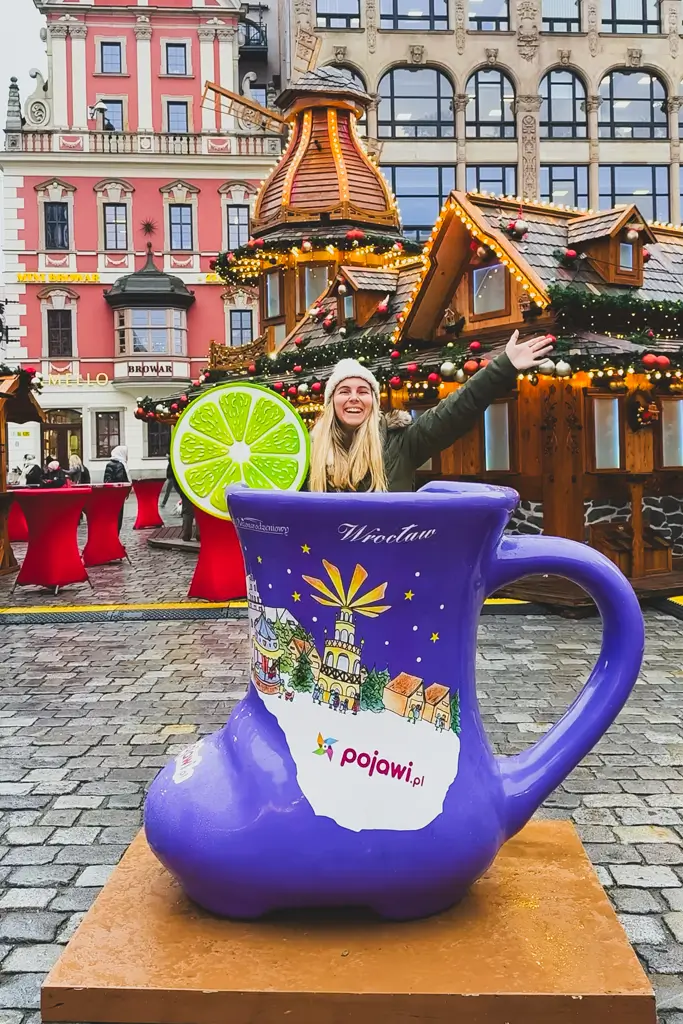
Meanwhile, three stalls over, the same mug sells for €15–20 if you buy it outright.
We kept one ceramic mug from each city that had one, and they’re now among our favorite holiday decorations.
Am Hof in Vienna has the most beautiful designs we’ve seen anywhere — their mug is the first to go out each December as part of our decorations.
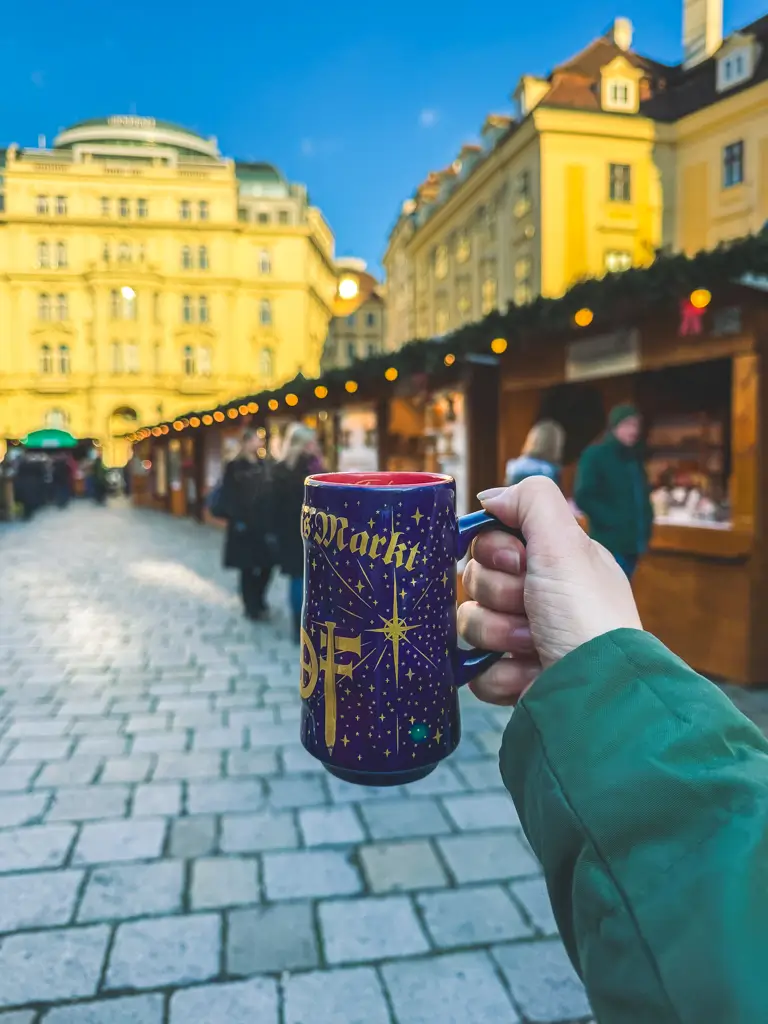
A few practical notes on the mug system:
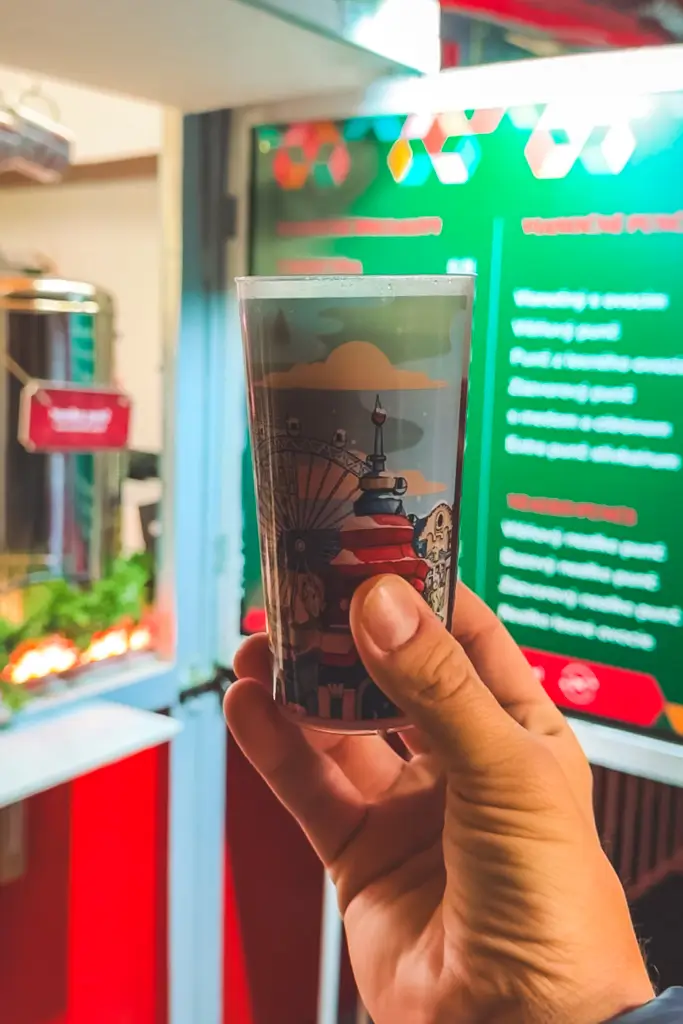
- Ceramic is worth keeping; plastic usually isn’t. Vienna’s ceramic mugs carried a €5 deposit. Bratislava, Tallinn, and Riga used plastic cups for about €2. We kept only the ceramics.
- Not every market has them. We couldn’t find a single ceramic Christmas market mug in Bratislava, which was disappointing.
- You can usually return a mug anywhere. In Bratislava, you could return cups from the Hviezdoslavovo Square market at the Main Square, so we moved between the two without losing our deposits. However, you can’t move between cities or countries with them and expect cash back.
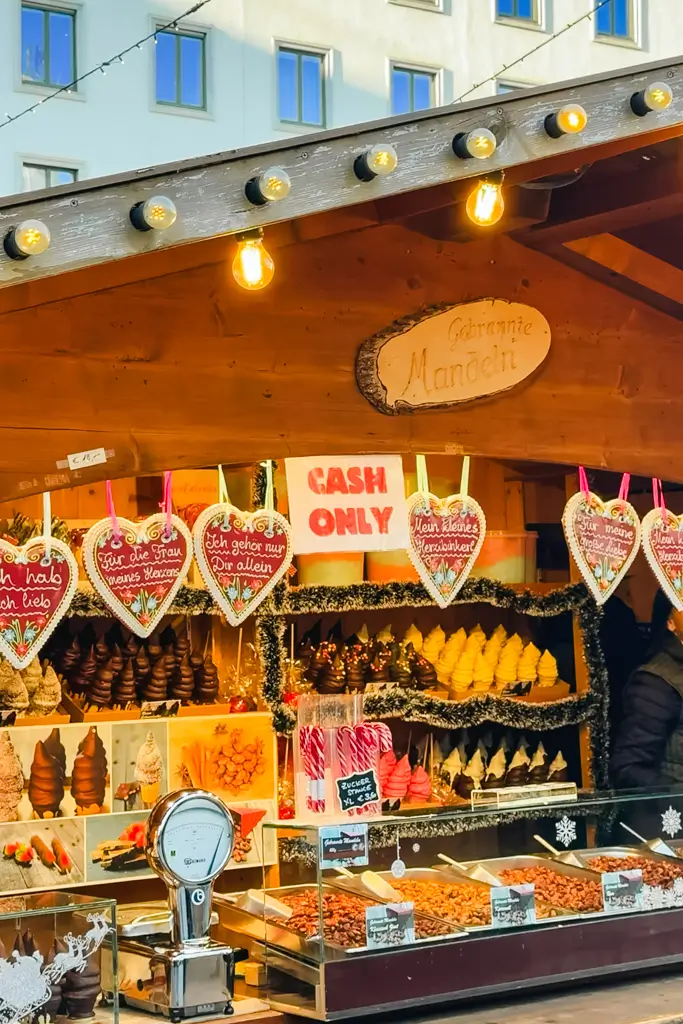
- Use it to get cash. Pay for your first drink with a card, then return the cup for cash. The vendor hands you coins, and suddenly you have perfect small change for all the cash-only craft stalls. This solved our small-bill problem for the entire European Christmas markets trip.
For more info on how everything works, check out our comprehensive post about European Christmas markets.
What Things Actually Cost
Prices vary by city, but here’s what we paid in seven countries so you can budget before you go.
| Item | Typical price |
|---|---|
| Ornaments | €10–20 (handmade at the higher end) |
| Glühwein Christmas market mug, bought outright | €15–20 |
| Glühwein Christmas market mug, via deposit | €2–5 |
| Hand-knitted mittens (Baltics) | From €50 |
| Hand-knitted sweaters (Baltics) | Up to €150 |
What to Buy at European Christmas Markets, Country by Country
The regional stuff is the whole point of going somewhere in particular.
Anything you can buy in four countries isn’t a Christmas market souvenir you’ll cherish forever.
Austria
Vienna’s markets had the highest craft quality of any place we visited, and we spent the most at Karlsplatz because the work genuinely impressed us.
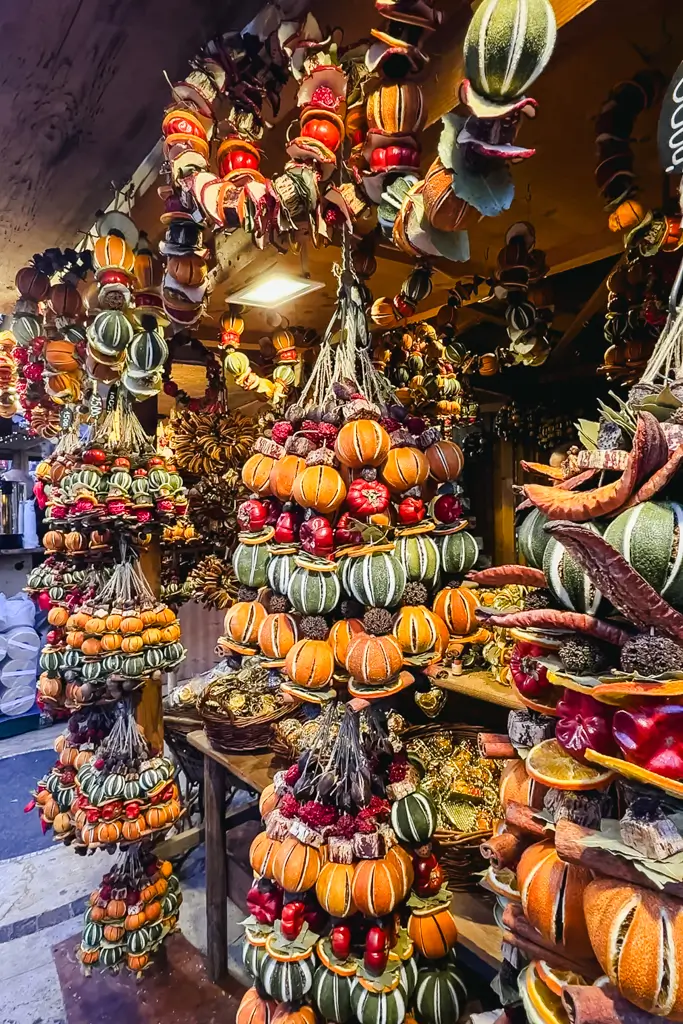
- Hand-blown glass ornaments — Schönbrunn and Belvedere both had glasswork that was clearly carefully crafted. At Schönbrunn in particular, I expected the palace market to lean heavily on the same mass-produced souvenirs you see at many big-name markets, but I found far more craftsmanship and variety than I expected
- Hand-knitted scarves and locally made candles — Maria-Theresien-Platz had fewer stalls than the larger markets, but we found hand-knitted scarves, locally made candles, and wooden toys that differed from those at the other markets
- Wood carvings — well beyond typical souvenir-grade at Schönbrunn
- Lebkuchen (gingerbread) — Decorated hearts, intricate houses, and cookies shaped like everything from pretzels to Christmas trees feature complex spice blends—cinnamon, cloves, cardamom, and sometimes black pepper
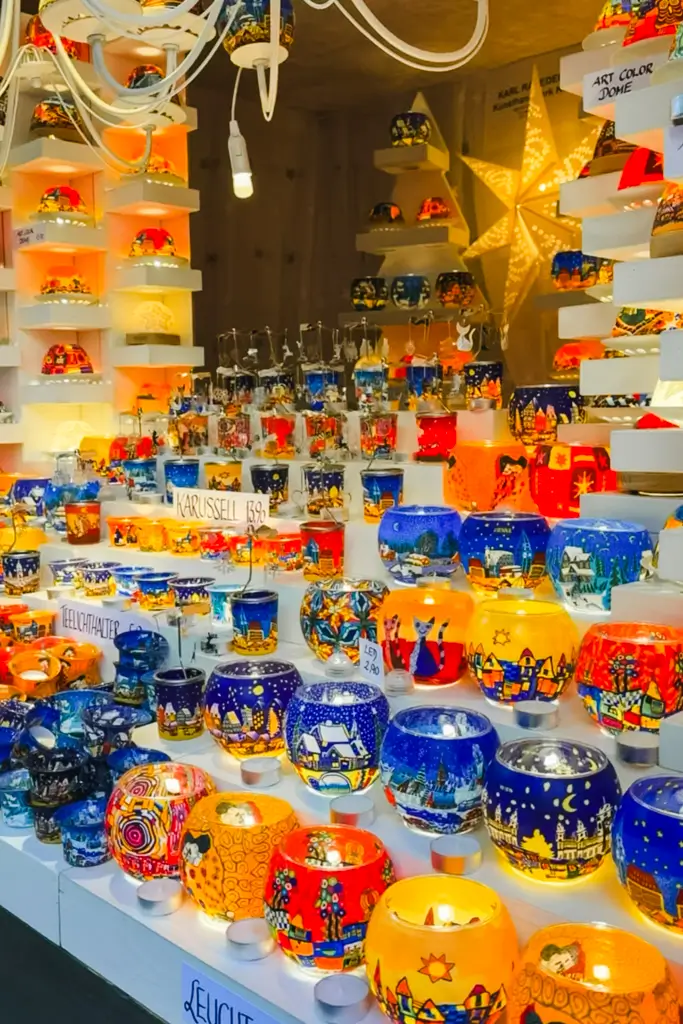
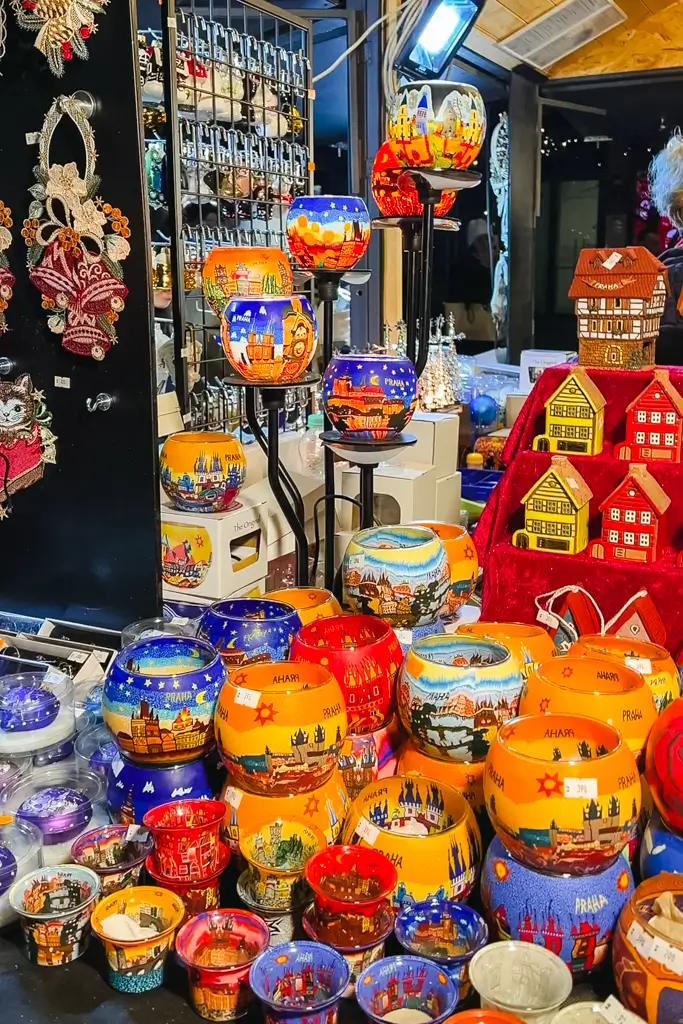
- Handmade gnomes and illustrated glass domes — Spittelberg had both, and they were the two things I most wish I’d bought more of. I loved the gnomes right away, and I kept hoping to run into them again at another Vienna market, but I never did. The glass domes sit over a tea light, illuminating illustrations of Vienna from the inside. We didn’t see anything like them anywhere else on the entire trip. If you see something at Spittelberg you love, buy it there!
Hungary
Budapest’s crafts lean traditional, and the quality range is wide, from mass-produced souvenirs to genuinely fine work.
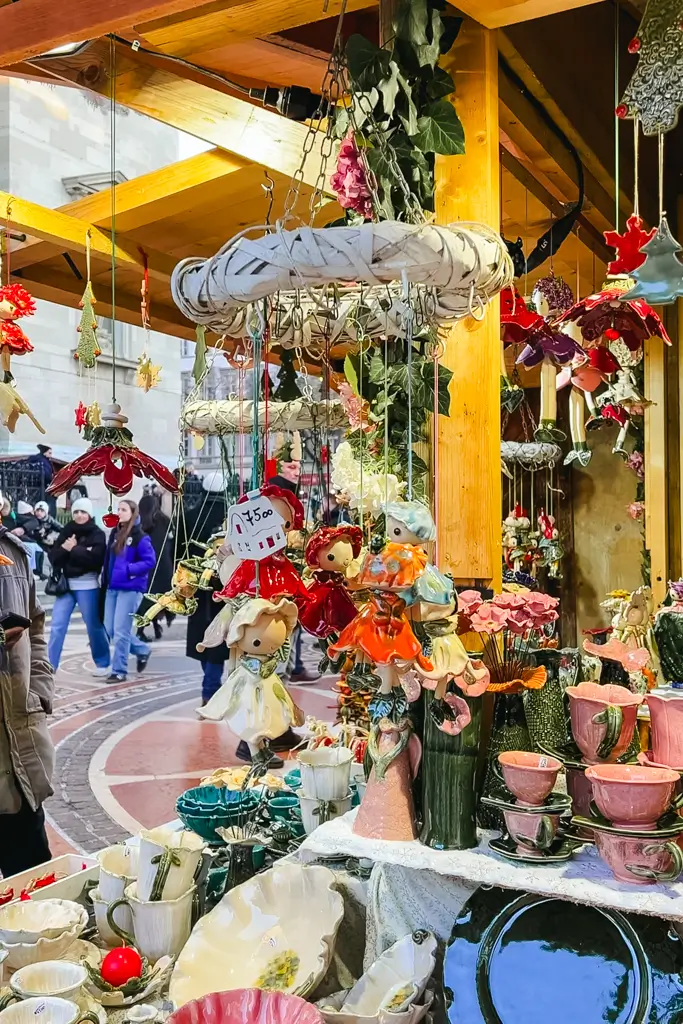
- Herend porcelain — expensive, exquisite, and unmistakably Hungarian, with each piece crafted and painted entirely by hand using traditional, highly labor-intensive techniques
- Embroidered textiles — a rich folk-art tradition marked by distinct regional styles, vibrant floral motifs, and meticulous hand-stitching
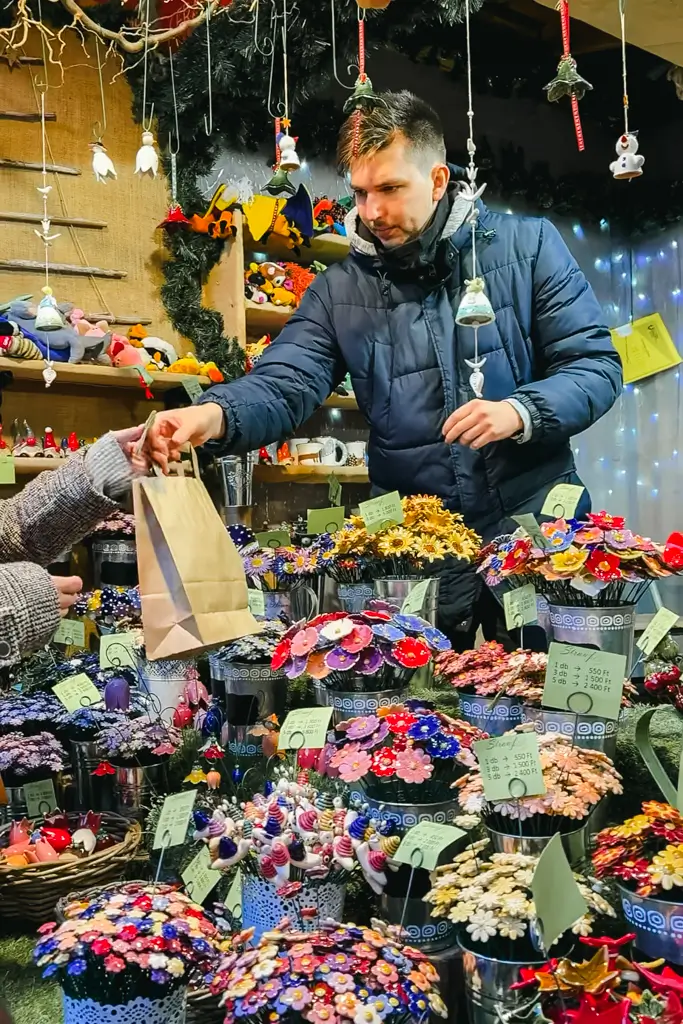
- Painted eggs — Hand-painted or blown eggs (hímes tojás) are primarily an Easter tradition, but these artisan wooden or blown-egg ornaments are sometimes used as folk-art Christmas tree decorations
- Wooden toys — Traditional Hungarian wooden toys and Christmas crafts feature carved folk designs, painted figures, and pull toys
Slovakia
- Hand-painted ceramics with traditional Slovak patterns
- Carved wooden toys and ornaments — this is where we watched the carver at work on intricate wooden toys and ornaments
- Leather and metal goods
- Embroidered textiles — these surprised us by looking modern rather than costume-like
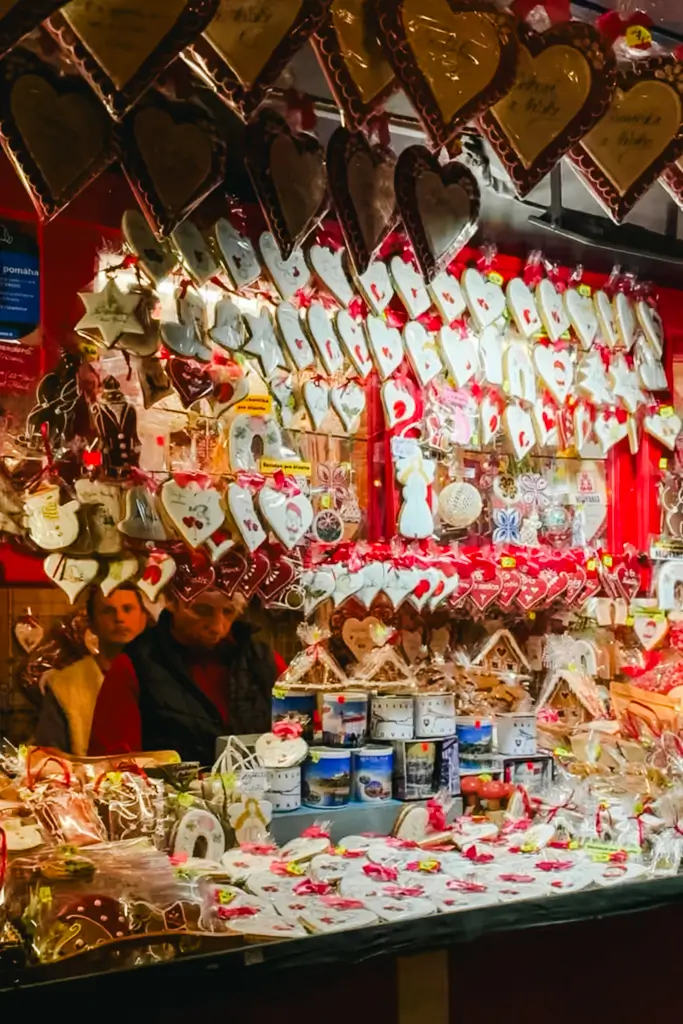
- Medovníky — intricately decorated Slovak spiced honey gingerbread cookies that are almost too pretty to eat!
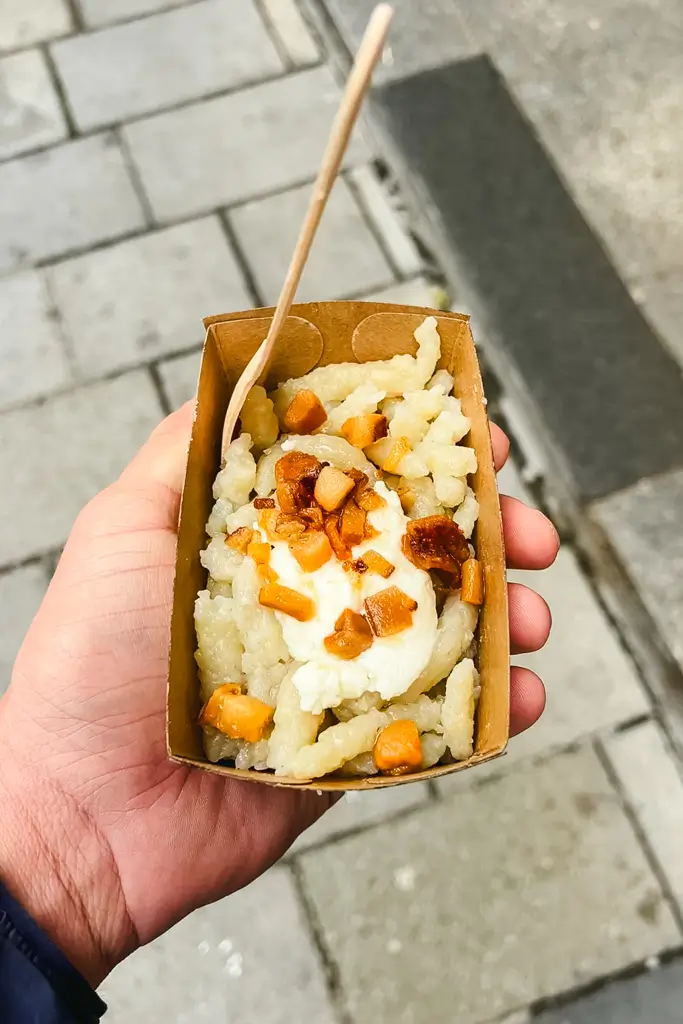
Honestly, though, the most memorable thing we brought away from Bratislava wasn’t an object at all. It was the halušky — potato dumplings with sheep’s cheese and bacon, €8 for an delicious plate.
Slovakia’s markets are food-forward rather than souvenir-focused.
Czechia
- Czech crystal and glass ornaments — Most traditional glass ornaments originate in the Crystal Valley region in northern Bohemia, where glassmaking dates back to the 13th century
- Traditional marionettes — a famous Czech folk art tradition featuring handcrafted wooden string puppets that represent traditional holiday figures such as Saint Nicholas (Mikuláš), angels, and jesters
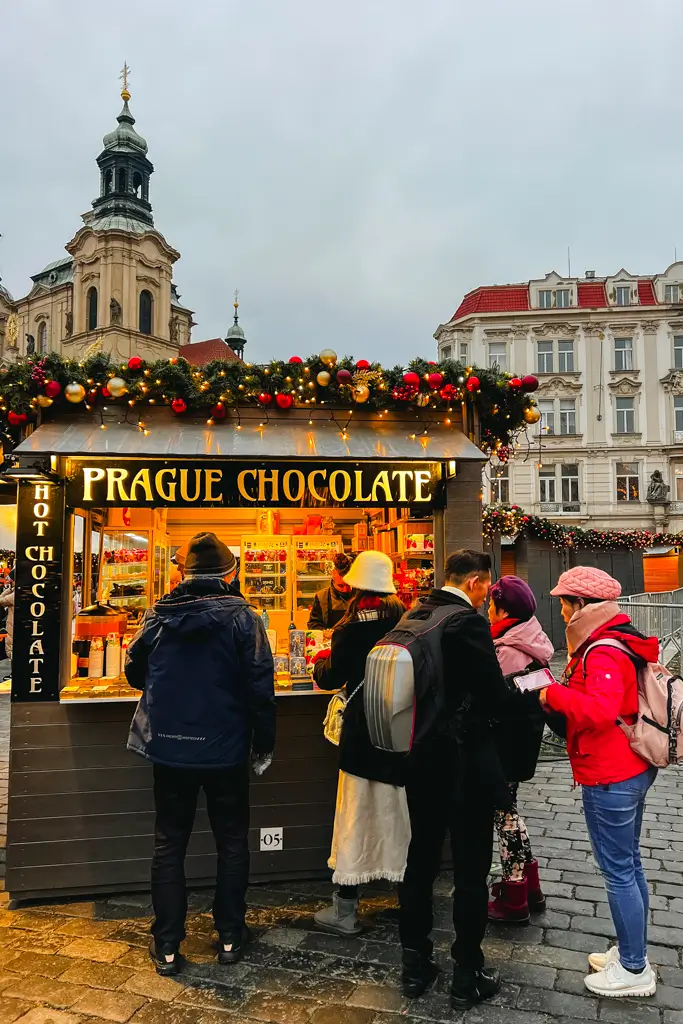
Note: prices drop noticeably as you move away from Old Town Square. The markets on the Lesser Town and Kampa Island offered the same kind of work without the Old Town markup.
Poland
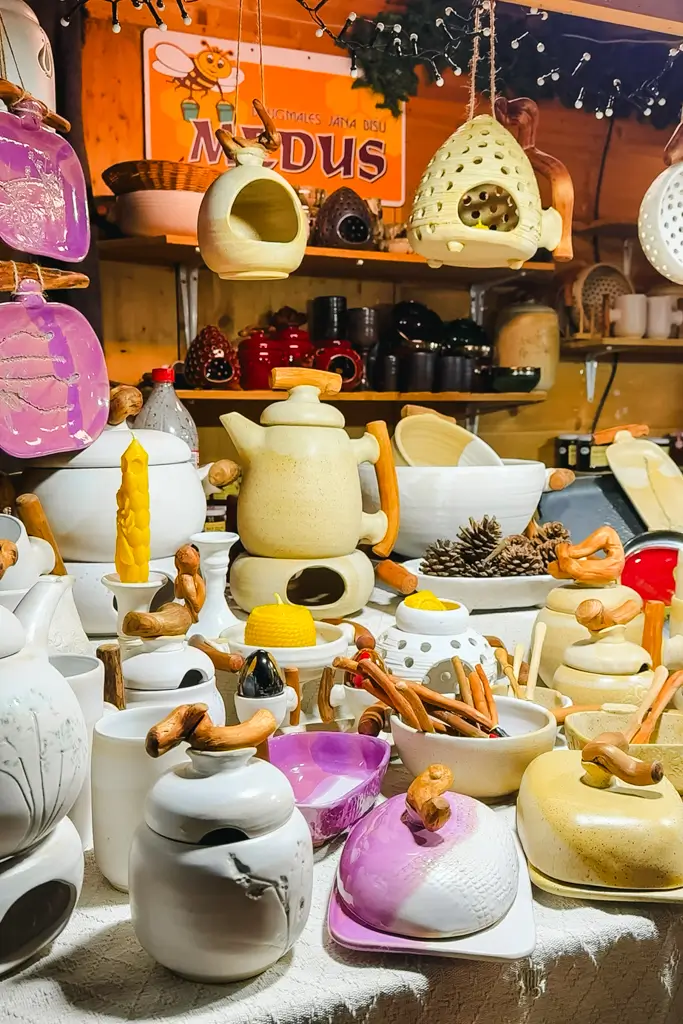
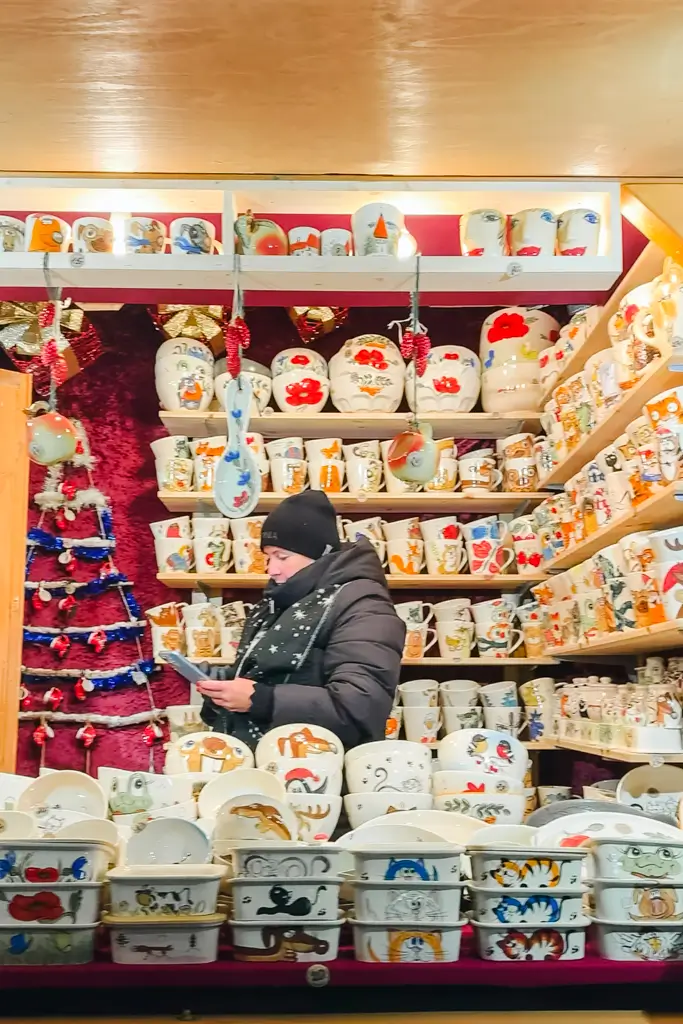
- Polish pottery — the distinctive blue-and-white patterns (Bolesławiec pottery, aka Polish stoneware), bought directly from artisans at prices well below those charged by tourist shops elsewhere
- Leather goods
- Folk art — hand-carved wooden toys, embroidered goods like aprons and bibs, and ceramic pieces such as bowls and mugs. The crafts in Wrocław felt handmade rather than mass-produced, in a way that a lot of markets didn’t.
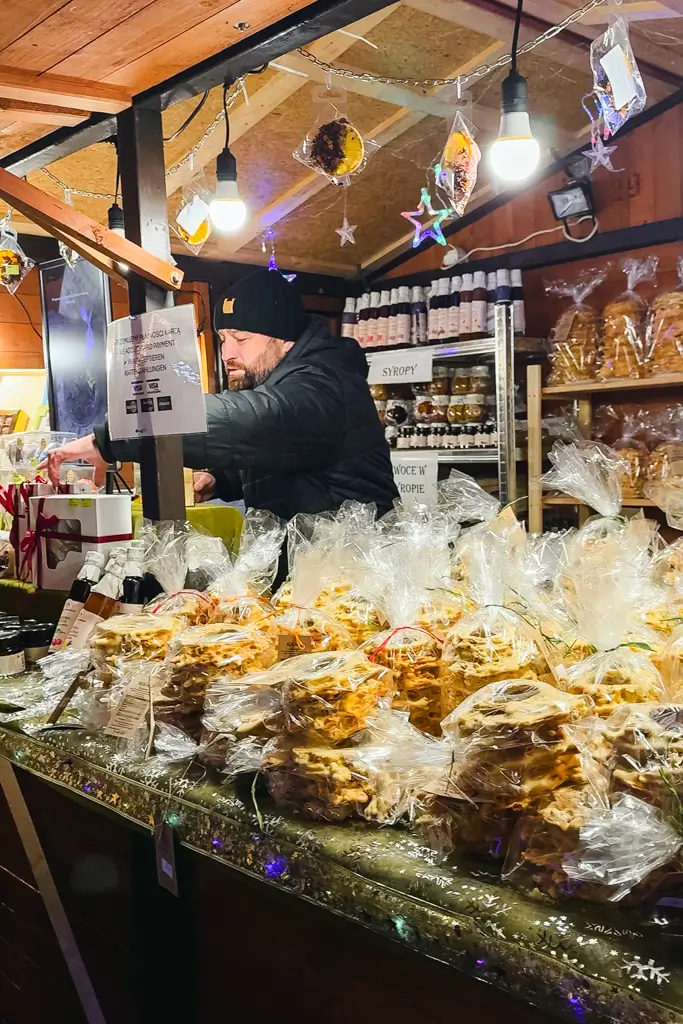
- Baked goods — delicious baked goods everywhere! Lots of traditional items that were made right in front of us!
Estonia and Latvia
The Baltic markets had the best value-to-quality ratio of the entire trip.
- Amber jewelry — Amber, known as “Baltic gold,” is deeply tied to Latvian and broader Baltic culture. In Riga, we found genuine Baltic amber of exceptional quality at truly reasonable prices.
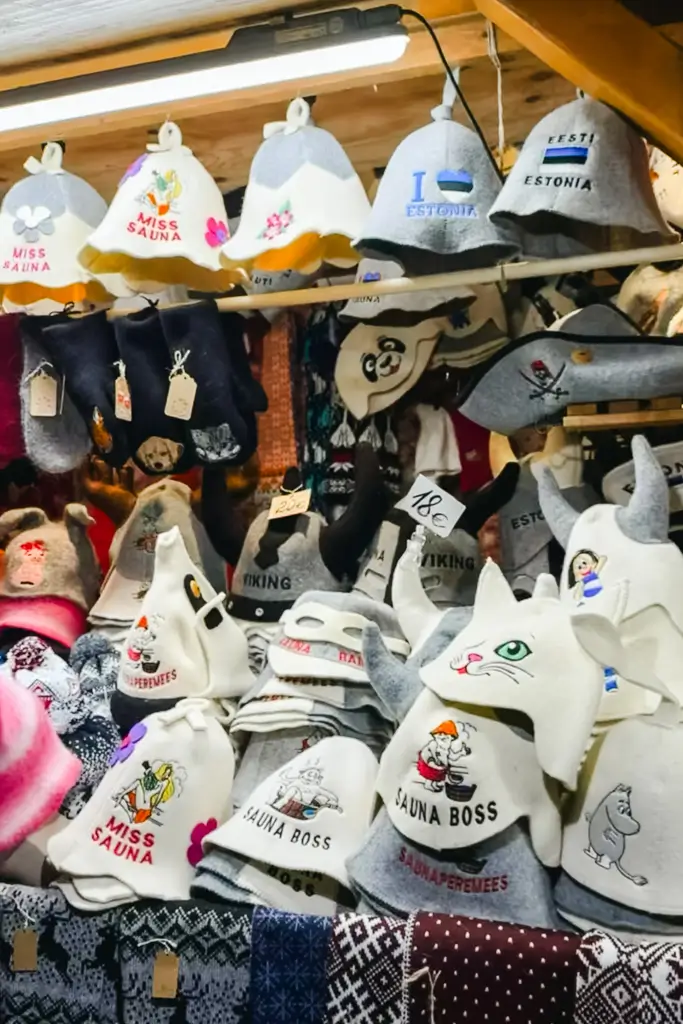
- Hand-knitted and crocheted wool — Estonia and Latvia were full of it: mittens, scarves, hats, and sweaters, all clearly handmade. Mittens started around €50, and sweaters ran up to about €150. That’s an investment compared with the other Christmas market gifts you can buy, but it’s also the kind of piece you’ll still own in twenty years.
- Baltic woodwork — Exquisite hand-carved wooden bowls, toys, and utensils crafted by local Baltic artisans at the renowned Tallinn Christmas Market
What’s Worth Buying Anywhere
A few things are genuinely good buys, regardless of which market you’re in.
Mulled wine spice packets. Sold at many stalls pouring drinks. The easiest way to bring the experience home for family and friends to try. They weigh nothing and work for non-alcoholic cider, too.
Local food you can legally carry. Vacuum-sealed and clearly labeled with the country of origin, making customs straightforward. Baked goods like Stollen (traditional German fruit bread) and Lebkuchen travel better than you’d expect.
Candles. Handmade, everywhere, and perfectly on theme — the markets exist because December is dark. Learn more about the origins of European Christmas markets in our guide.
Wool accessories. Scarves, hats, and mittens, especially from the Baltic and Alpine markets, where the knitting tradition goes back generations. Also a wonderful gift for someone back home who may be living or visiting somewhere that gets chilly soon.
Christmas Market Souvenirs We’d Skip
Anything you’ve seen at a previous market is the strongest signal. If you see it again and again, and it’s exactly the same, then it’s something widely produced.
Mass-produced ornaments. Every market has at least one stall selling the same stuff you could buy at any gift shop back home. Nothing wrong with it if you love it; just don’t pay a premium for it.
Souvenir Glühwein mugs. See above, as there’s a much more cost-effective way to take one home.
Heavy jarred goods. Jams and honey are lovely, but they’re also the fastest way to blow your luggage weight limit. Buy one, not six, for all your friends and family back home.
Anything fragile you don’t have a plan for. Which brings us to the harder part: getting all your Christmas market gifts back home!
And the one thing we actually regretted: eating meals inside the biggest markets.
We don’t regret a single souvenir we bought. What we’d take back is how often we ate inside the large, famous markets.
In several cities, we could have walked just outside the market and had a full sit-down meal for about what we paid to stand in the cold.
Sample the market food—that’s part of the experience, and smaller markets especially have far more homemade options—but don’t make big-name markets your default for every meal.
Getting It All Home Safely
We flew home with a roller carry-on and a backpack each, the same bags we’d carried for two weeks across seven countries to visit these underrated Christmas markets in Europe.
Guess what? Every single ceramic Glühwein mug made it back unbroken!
Buy less than you think. We spent about €100 on souvenirs for the entire trip, and that was enough to come home with something from every country. At some markets, we bought nothing. The ones where we spent more—especially Vienna’s Am Hof—were worth it because of the quality of the items.
Carry a packable tote. Most market stalls don’t provide a bag, so you’ll otherwise be carrying purchases without one. A tote that folds down to nothing solves the problem.
Wrap breakables in your puffiest layers. We packed extra puffy jackets specifically for this job and carefully wrapped each mug before it went into the bag. Your winter gear is better padding than anything you’d buy for the purpose, and it’s already coming with you.
Consider a padded wine suitcase. We met travelers who brought one specifically for mugs and other breakables, and they swore by it. If you’re planning to buy a lot of glass or ceramics, it’s a smarter investment than a roll of bubble wrap.
Wear your bulkiest layers on travel days. Your coat and snow boots take up a lot of suitcase space, so wear them to free up space.
Keep fragile items with you. Checked bags are handled roughly. Christmas market souvenirs, such as glass ornaments and ceramic mugs, belong in your carry-on — that’s where ours traveled.
Know the basics of customs. Food requires country-of-origin labeling. For US visitors, all food must be declared, and meat products are generally prohibited, but most craft goods clear without issue. If you’re buying something valuable, check the current duty-free allowance before you travel rather than guessing at the counter.
Final Thoughts
The best things we brought home weren’t the priciest ones.
They were the Glühwein mugs we’d been drinking from, the pieces we’d bought from people we’d watched make them, and the handful of regional items that could have come from only one place.
Shop more slowly than you think you need to. Do a lap first to get at least a glance at what’s on offer. Ask the vendor about their work.
And if something genuinely stops you in your tracks — say, those Spittelberg gnomes — buy them, because there’s a chance you won’t see them again.
And when you find the stall where someone is actually making something right before your eyes, that’s where your money is best spent.
If you need more help, check out our guide to planning a trip to Europe’s Christmas markets.
FAQs
Do Christmas market vendors take cards?
Many Christmas market vendors accept credit or debit cards, but cash remains essential because acceptance varies from vendor to vendor.
Larger food vendors often do; smaller craft stalls frequently don’t, and some card-accepting vendors set €10–15 minimums.
Carry cash and use the mug deposit trick to keep replenishing coins.
What should I buy at a Vienna Christmas market?
Schönbrunn and Belvedere both had hand-blown glass ornaments that were clearly locally made, with a glassblower demonstrating his technique right at his Belvedere stall.
Karlsplatz is the place for Austrian woolens and contemporary Austrian design at prices that won’t wreck your budget.
Spittelberg is where we found handmade gnomes and illuminated glass domes featuring illustrations of Vienna — neither of which we saw at any other market in the city.
And keep your €5 ceramic mug. Vienna’s are worth it.
What do they sell at Christmas markets?
Hot drinks and food from an outer ring of stalls, regional crafts from an inner cluster, and a certain amount of mass-produced souvenirs are sold at nearly every Christmas market.
Crafts typically include hand-blown glass ornaments, wood carvings, knitted woolens, candles, ceramics, and regional specialties that vary by country — amber in Riga, Polish pottery in Wrocław, and Czech crystal in Prague.
How much of it is genuinely handmade varies widely.
Are Christmas market souvenirs expensive?
Christmas market souvenirs don’t have to be expensive.
We spent about €100 total across seven countries.
Ornaments run €10–20, and Glühwein market mugs cost nothing beyond the €2–5 deposit you’re already paying.
Hand-knitted Baltic wool is the exception — mittens start around €50 and sweaters reach €150 — but that reflects the intense labor required to create them.
