
What Are European Christmas Markets? A First-Timer’s Guide to How They Work

The Mobile Homie contains affiliate links and is a participant in the Amazon Services LLC Associates Program, as well as other affiliate programs. If you click on a link or make a purchase through one of these links, we may earn a small commission at no extra cost to you. For more details, see our Privacy Policy.
European Christmas markets show up on your feed every November. Rows of little wooden huts, a tree the size of a building, everybody holding a mug and looking unreasonably happy about standing outside in the cold.
And then you start looking into it, and the first-timer questions pile up fast. What are European Christmas markets? Do you pay to get in? What is everyone drinking? Why does the mug cost extra? Are they all basically the same?
JT and I had most of those questions too, right up until we landed in Budapest in December 2024 and began a run through seven countries. We hit Budapest, Bratislava, Vienna, Tallinn, Riga, Wrocław, and Prague, spending two days in each city. By the end, we had answers to questions we didn’t even know to ask (including why you should absolutely pay for your first drink with a card — more on that below).
This guide covers the differences between European Christmas markets, where they originated, and how the logistics work, so you can decide whether that plane ticket is worth it during the peak holiday season.
What are European Christmas Markets?
A European Christmas market is a seasonal open-air market held in a public square during Advent, typically from late November through Christmas Eve.
Temporary wooden stalls sell hot drinks, regional food, and handmade crafts, and the market serves as much as a gathering place for the city as a place to shop.
That last part is what most first-timers miss.
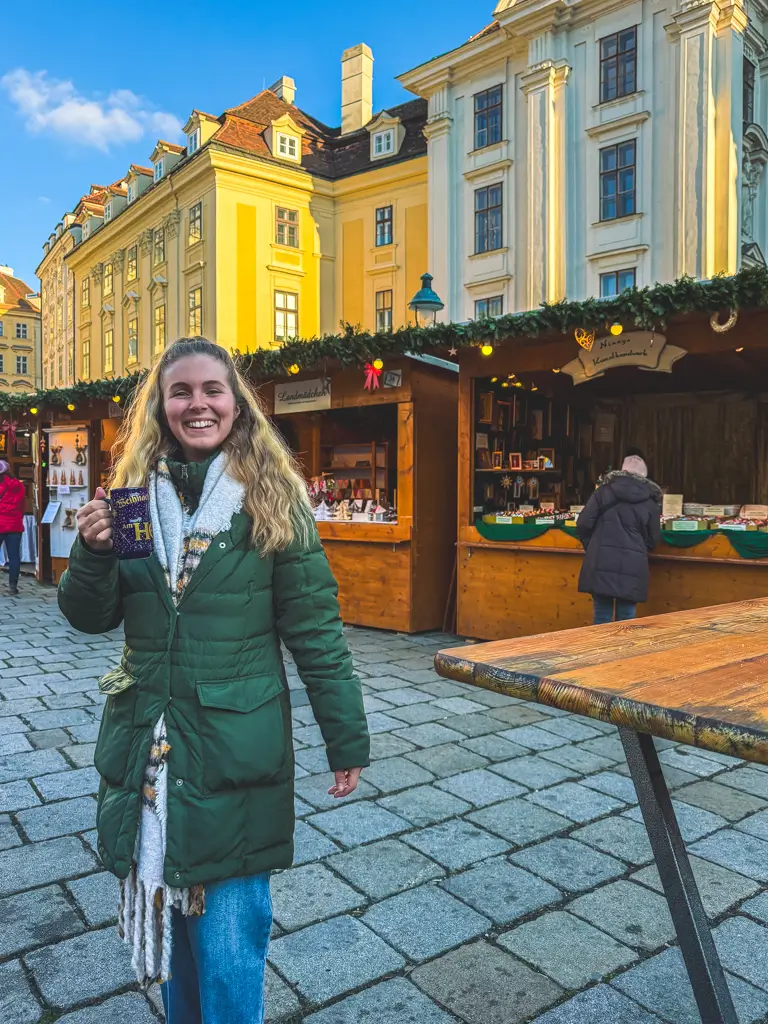
We went in expecting “outdoor Christmas shopping.” What we found was more like an outdoor living room. People show up after work, order a glühwein, stand at one of those tall tables for an hour with their coworkers, then go home.
They aren’t buying anything. They’re just there because it’s December, and this is where everyone is.
Once that clicked for us, the whole experience made more sense. You’re not there to check stalls off a list. You’re there to stand around in the cold with a warm drink, which sounds ridiculous, but that’s community building in action.
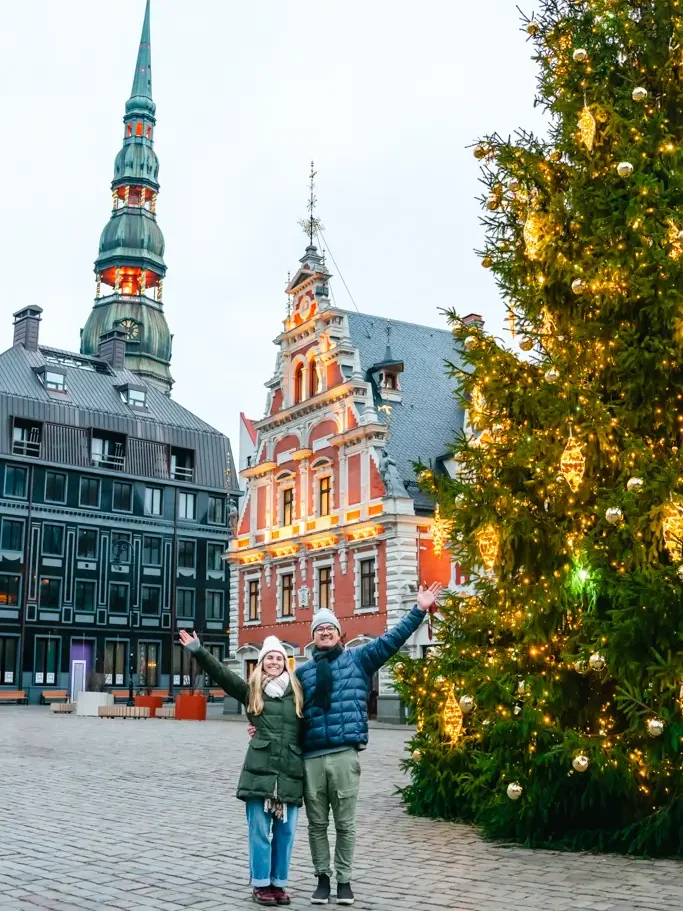
Weihnachtsmarkt, Christkindlmarkt, Adventmarkt — What’s the Difference?
Mostly regional naming, not fundamentally different events.
- Weihnachtsmarkt is the general German term for Christmas market.
- Christkindlmarkt (or Christkindlesmarkt in Nuremberg) refers to the Christ Child, the gift-bringer figure in much of southern Germany and Austria. Nuremberg’s is the most famous.
- Adventmarkt is common in Austria and emphasizes the Advent season.
- Mercatini di Natale in Italy
- Marché de Noël in France
- Vánoční trhy in Czechia
Practically speaking, most European Christmas markets look similar, so don’t be thrown by the naming.
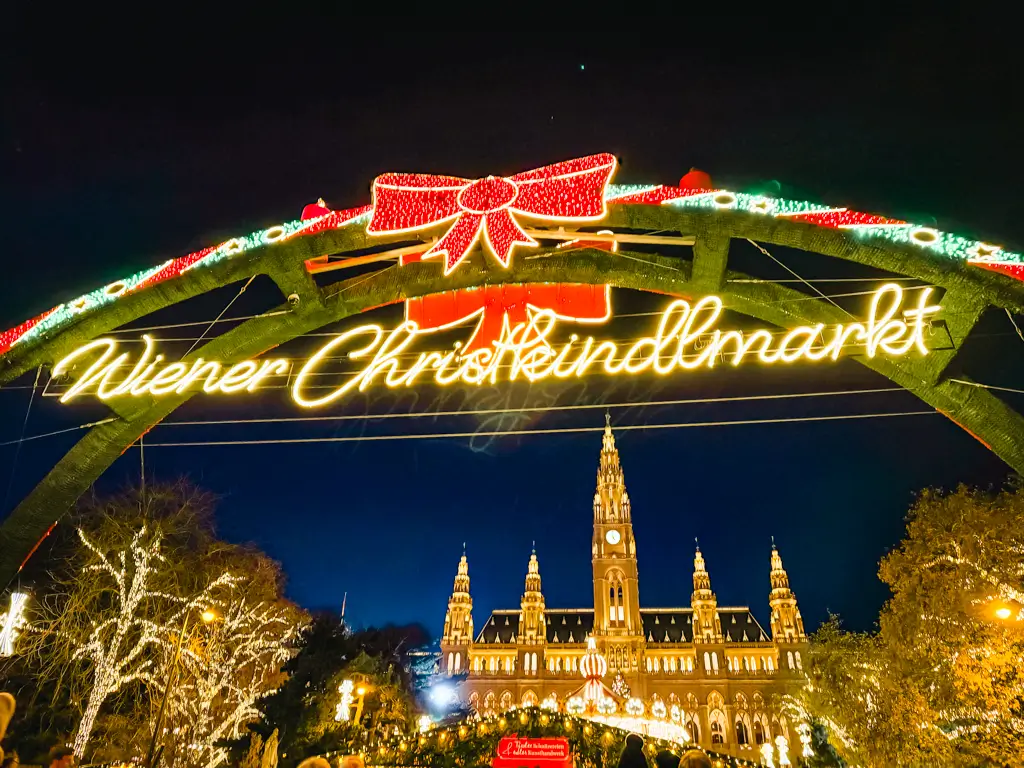
Where Christmas Markets Came From
Christmas markets didn’t start as a festive experience.
They started as a practical one.
In medieval Europe, the weeks before Christmas were your last chance to stock up before winter shut things down.
Roads got bad, and Advent was a fasting period, so towns held a market right before it ended, where you could buy meat, candles, baskets, and whatever else you needed to get through to spring and to put a proper meal on the table.
Carved nativity scenes arrived with the Counter-Reformation. The Christkind figure replaced St. Nicholas in Protestant areas. Trees and lights appeared in the 1800s.
Quick Christmas Market dates:
- Vienna had a December market by around 1296
- Munich’s market was documented as a St. Nicholas market in 1310
- Bautzen’s Wenzelsmarkt dates to 1384
- Frankfurt’s to 1393
- Dresden’s Striezelmarkt was first recorded in 1434, and it’s the oldest continuously documented true Christmas market still running
- Strasbourg’s Christkindelsmärik followed in 1570
You’ll see many cities claim to be “the oldest,” but Dresden has the strongest case.
What to Buy at European Christmas Markets + Regional Variations
After enough markets, you start noticing that most of them follow the same blueprint.
There’s usually a giant tree, often a nativity scene, sometimes a stage for choirs or brass bands, an outer ring of food and drink stalls, and an inner cluster of craft vendors.
What doesn’t repeat is the city around them, the regional food, and the local drink—and that’s where the real differences lie.
The Food
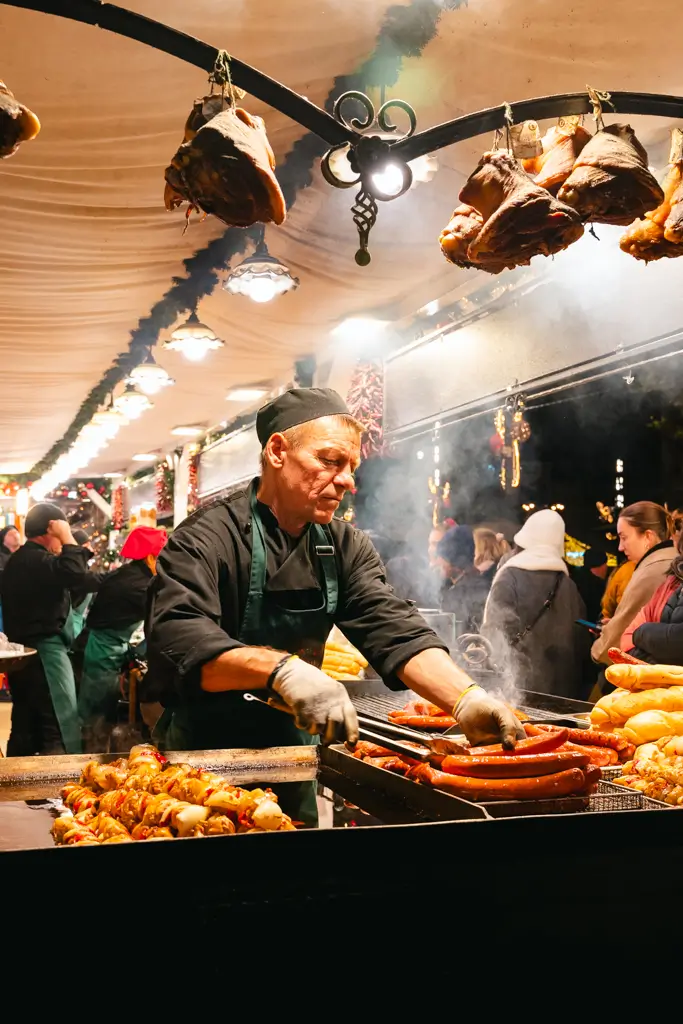
Some things show up at nearly every market, regardless of country: grilled sausage, enormous pretzels, roasted chestnuts, crepes, potato pancakes, and some form of fried dough.
Then there’s the regional stuff, which is why you go to certain markets.
Our best food experience of the trip happened by accident at Vienna’s Christmas Markets on Rathausplatz.
We were warming up with a glühwein when the smell from a nearby booth became impossible to ignore.
It was kiachl — Austrian fried dough, served hot with tart cranberry sauce or sauerkraut. The vendor told us he’d been making it the same way his family had for three generations.
We went back a second time, possibly a third.
Elsewhere on the trip:
- Halušky in Bratislava (potato dumplings with sheep cheese and bacon, €8 for a huge plate)
- Pierogi in Wrocław that ruined all other pierogi for us
- Lángos in Budapest
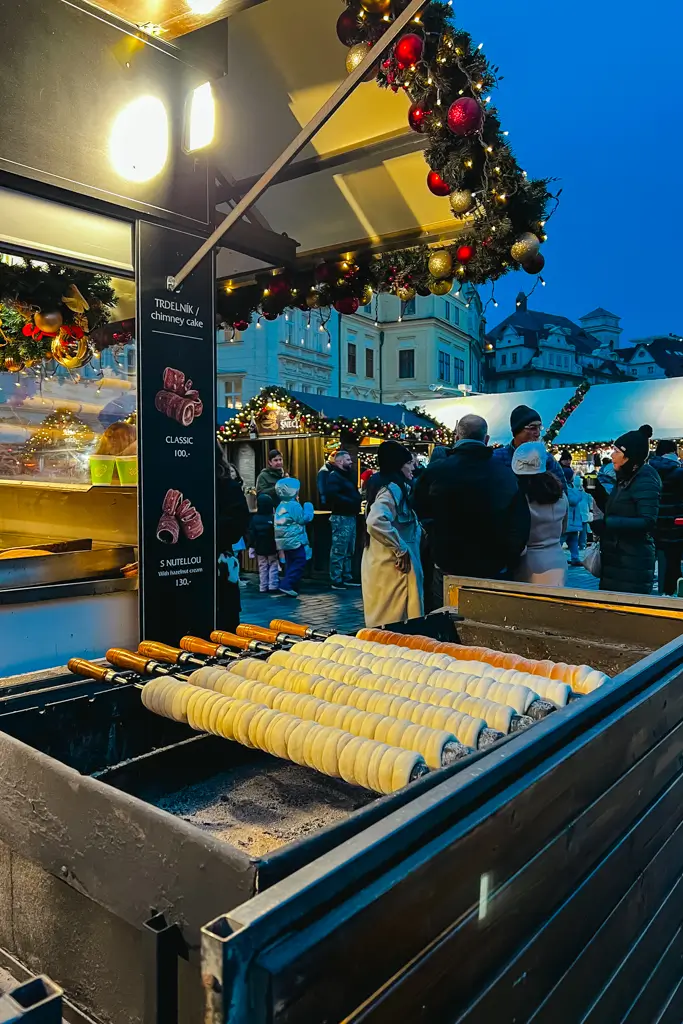
- Trdelník in Prague
- Stollen in Dresden
Come hungry. Seriously, don’t eat before you go, or you’ll regret it!
The Drinks
Glühwein is the default — red wine heated with cinnamon, cloves, star anise, citrus, and sugar.
Quality varies enormously. We had versions that tasted like Christmas in a cup and others that were essentially hot grape juice with a splash of wine. Usually €3–5.
The best versions use quality wine as the base and blend spices carefully. If you’re unsure what it’s made with (aka can’t see if it’s made from powdered spice packets), stick to the regional variations, as that’s where it gets more fun:
- Punsch (Austria) — fruit-based, often apple or cherry, spiked with rum. JT got completely hooked on apple punsch in Vienna.
- Svařák (Czechia) — Czech mulled wine, heavier on cloves and lighter on cinnamon than the German version.
- Feuerzangenbowle (Germany) — a rum-soaked sugar loaf set on fire over mulled wine. It’s dinner theater.
- Bombardino (found in Prague) — egg liqueur and brandy under a mountain of whipped cream. It tastes like liquid dessert. JT ordered a second one before he finished the first.
- Medovina — honey wine, common in Slovakia and Poland.
Note: You don’t have to drink alcohol to enjoy these markets.
Bratislava’s non-alcoholic punč was €2.50, and the strawberry version was genuinely the best thing I tasted on my entire seven-country, 10-day European Christmas Market trip (distilled down from our 14-day journey).
Hot chocolate at European markets is nothing like the powdered stuff in the United States—it’s thick and usually topped with real whipped cream. (JT claims he had “only” six cups in Vienna. I counted more.)
The Crafts
This is where European Christmas markets differ the most.
Some are full of genuinely handmade work. Others are 70% stuff you could buy at any souvenir shop.
A few tells we picked up:
- Hand-knitted vs. machine-knitted: machine stitches are perfectly uniform. Handmade pieces show slight variation, and they cost more because they should, given the level of work.
- Watch for people working at their stall. We watched a glassblower in Vienna demonstrate his technique and a woodcarver in Bratislava work at his booth. That’s the good stuff that you know didn’t come from a shipping container.
- Some markets enforce it. Nuremberg restricts what can be sold in favor of handmade, locally produced goods. Most markets don’t.
Things actually worth suitcase space: hand-blown glass ornaments, amber in Riga, Polish pottery in Wrocław, Czech crystal in Prague, Austrian woolens.
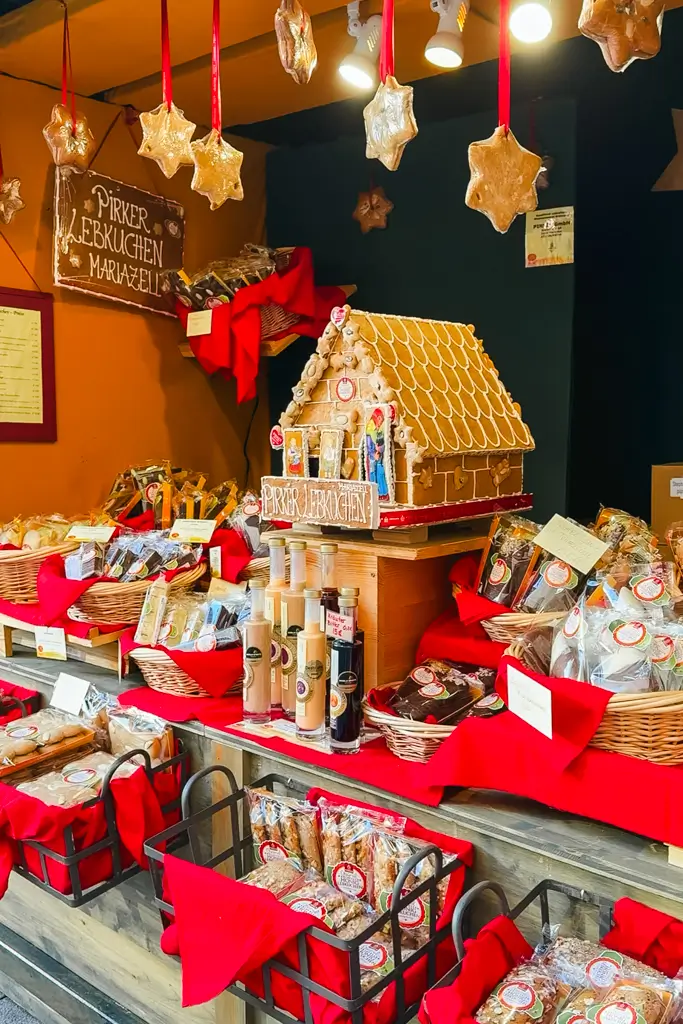
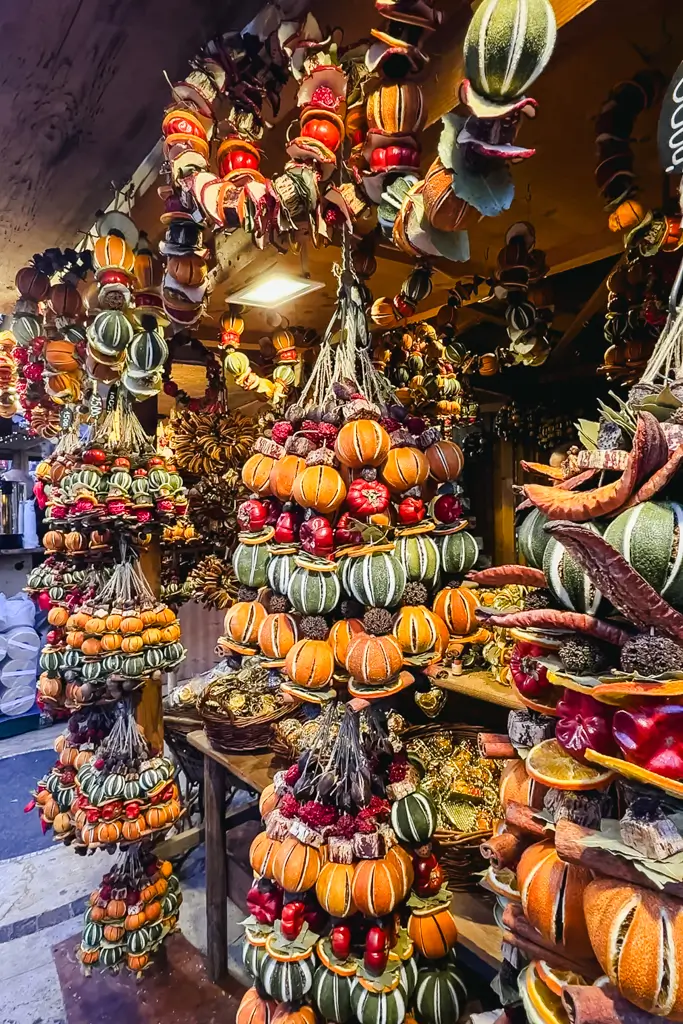
For more info on what you can expect from sourveniors, check out our comprehensive post on what to buy at European Christmas markets.
How Christmas Markets Differ Country to Country
The pattern we found is that the further east we went, the better the value and the thinner the crowds.
Austria and Hungary gave us the grand, imperial version — spectacular settings, higher prices, and a lot of other people.
Slovakia (such as Bratislava’s Christmas Markets), Poland, and the Baltics gave us markets where vendors had time to talk to us and a mug of something hot cost half as much.
| Country | Signature drink | Signature food | Price | Vibe |
|---|---|---|---|---|
| Austria | Apple punsch, glühwein | Kiachl, käsekrainer, strudel | €€€ | Imperial, polished, crowded |
| Hungary | Forralt bor, mulled wine | Lángos, kürtőskalács | €€ | Grand setting, heavy crowds |
| Czechia | Svařák, bombardino | Trdelník, klobása | €€ | Fairy-tale Gothic, great value |
| Slovakia | Punč, medovina, plum wine | Halušky, cigánska pečienka | € | Local, uncrowded, cheap |
| Poland | Grzaniec, mead | Pierogi, oscypek cheese | € | Big markets, tiny crowds |
| Baltics (Estonia, Latvia) | Spiced mulled wine, Black Balsam | Black bread, amber crafts | € | Medieval, atmospheric, cold |
You’ll notice Germany, France, and Switzerland aren’t in there. That’s on purpose — we built this trip around the underrated European Christmas markets rather than the famous ones, so Nuremberg, Strasbourg, and Zurich are still on our list.
Everything above is from markets we actually stood in.
How Do European Christmas Markets Work?
This is the section we wish someone had written for us before our first trip.
Are European Christmas Markets Free to Enter?
Yes. Almost universally, there’s no entrance fee or ticket.
You walk into the square, and you’re at the market.
That makes them one of the better travel values in Europe — you can spend an entire evening soaking up the atmosphere without spending a euro, then spend as much or as little as you want on food, drinks, and crafts.
The Mug Deposit System, Explained
This is what confuses everybody, and once you understand it, it’s actually a great value proposition.
When you buy a hot drink, you pay for the drink plus a deposit for the mug.
Deposits range from €2 to €5, depending on the market and mug type.
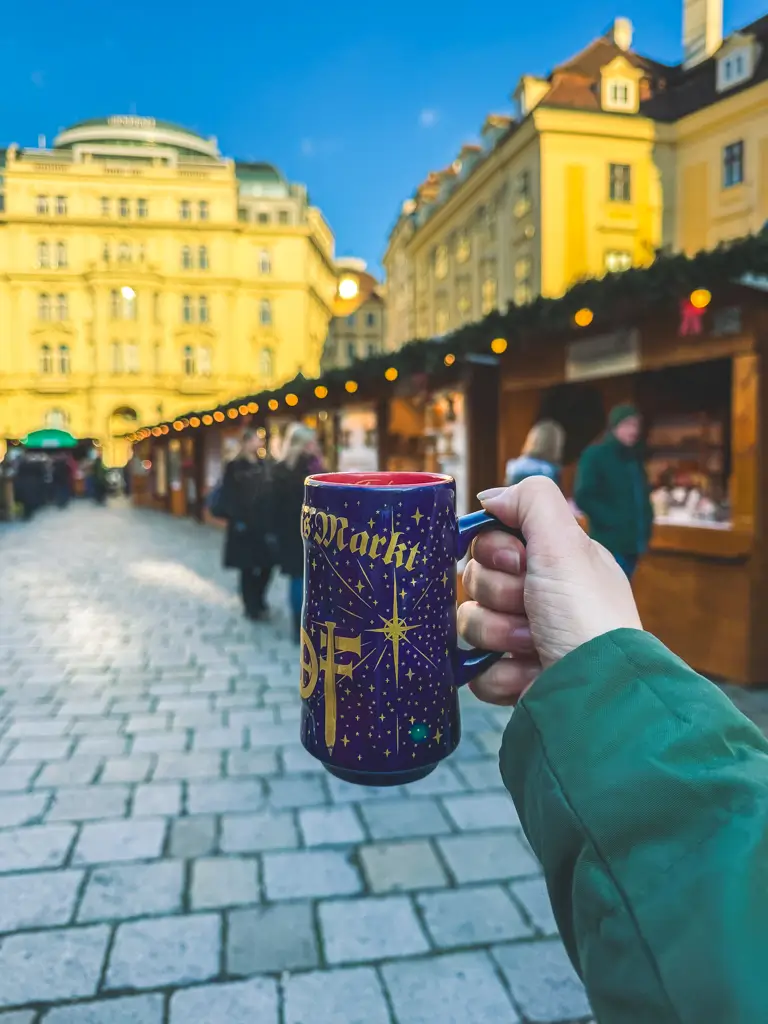
Plastic cups tend to be on the lower end (Bratislava, Tallinn, and Riga used plastic cups at around €2), and ceramic mugs on the higher end (Vienna’s were €5).
When you’re done, you have two choices:
- Return the mug to any vendor and get your deposit back in cash.
- Keep it. The deposit becomes the price of the souvenir.
Most markets design a new mug each year, often stamped with the year and the market’s name. We kept several, and they’re now among our favorite holiday decorations. At €3–5 each, they’re cheaper and more meaningful than anything in the official gift shop.
Two things nobody tells you:
You can usually return a mug to a different vendor than the one you bought it from, and sometimes to a different market in the same city. In Bratislava, cups from the Hviezdoslavovo Square market could be returned at Main Square, so we hopped between both without losing deposits.
And the trick we accidentally discovered: pay for your first drink with a card, then return the cup for cash. In Bratislava, the vendor handed us back the €2 deposit as a coin.
Suddenly, you’ve got perfect small change for the cash-only stalls without hunting down an ATM. It solved our small-bill problem for the entire trip!
Cash or Card?
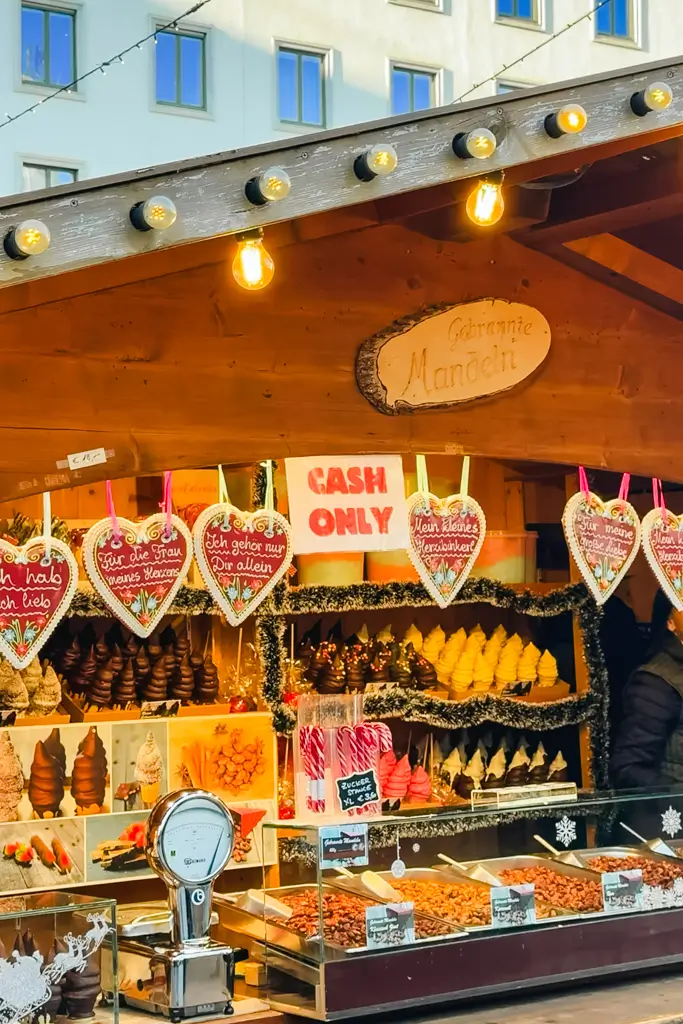
Bring cash. Card acceptance is wildly inconsistent, even within a single market.
In Vienna, larger food vendors and established craft sellers often accepted cards, but many smaller stalls were cash-only, and several card-accepting vendors had €10 or €15 minimums — which is rough when you want a €4 pretzel.
Bratislava surprised us in the other direction: roughly 65% of vendors accepted cards, including contactless.
After a few cities, our approach is to carry €40–60 in small bills and coins and use the mug deposit trick to keep replenishing coins.
What Time is Best to Visit a European Christmas Market?
Most markets run roughly from 10 AM to 10 PM, with some staying open later on weekends.
Weekend markets are significantly busier than weekday markets, meaning the same market feels like two completely different experiences depending on when you go.
During the day, it’s calmer. Vendors have time to talk to you. You can browse crafts without feeling rushed.
Am Hof in Vienna felt local at 11 AM—it was our favorite market of the trip, and the timing made all the difference.
Then the lights come on around 4 PM, and everything transforms.
The crowds build, the atmosphere grows electric, and it becomes postcard-perfect. Around 6 PM at Maria-Theresien-Platz, we watched people in business attire start filtering in — locals stopping for a glühwein on their way home from work.
If you can, visit the same market twice: once in daylight and once after dark to experience both.
Additional Planning Logistics
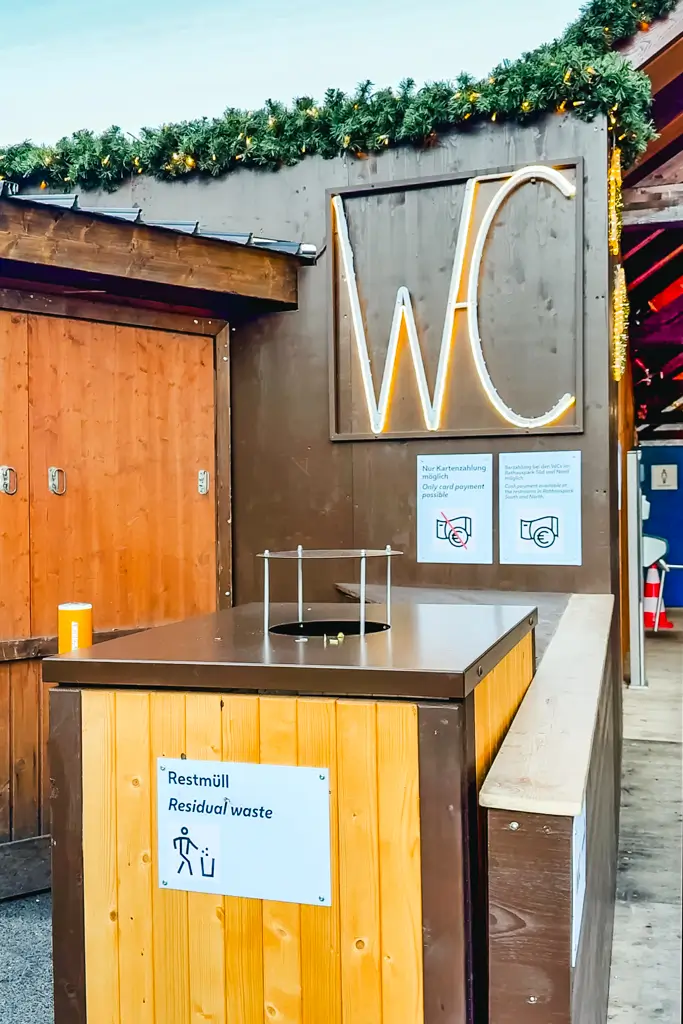
Bathrooms are scarce. Most markets we visited didn’t have any. Rathausplatz in Vienna did, and it cost €1 (card only). Plan around cafés and department stores.
It gets dark early. Sunset is around 4 PM in central Europe and closer to 3:30 PM in the Baltics. Your “afternoon” is shorter than you think.
Holiday closures are inconsistent. Markets that run past December 23 often close or close early on the 24th and 25th, reopen on the 26th, then shut again on the 31st and January 1. Every market handles it differently, so check individual schedules if your dates land on a holiday.
Are European Christmas Markets Worth It?
Yes, but manage your expectations, as some of the famous Christmas markets are overcrowded.
We stepped off the tram in Budapest expecting magic, only to find ourselves shuffling through a crowd of cruise ship passengers holding €8 mulled wine in plastic cups.
Vienna’s Stephansplatz was shoulder-to-shoulder at 10 AM, opening time. By market number fifteen, we could predict the stall layout before we walked in.
Conversely, Bratislava, which we added as a throwaway stop between Vienna and Prague, ended up being one we loved more than either of them.
Wrocław, which we booked as a filler, turned out to be the pleasant surprise of the entire trip.
The lesson we took away: the market rarely defines the experience. The city does.
The stalls are similar everywhere. What differs is the square they’re in, the food the region serves, the people standing next to you, and whether you have room to breathe.
So pick destinations you’d want to visit anyway, go on a weekday, go once in daylight and once after dark, and don’t try to see everything.
FAQs
When Do European Christmas Markets Open?
Most European Christmas markets dates run from the weekend before the first Sunday of Advent — typically in mid-to-late November — and close on December 23 or 24.
A handful run into early January, particularly in palace markets and some Eastern European markets.
The sweet spot is the first week of December through mid-month: everything is fully operational, and you’re ahead of the December 20–23 crush, when tourists and locals are both doing last-minute shopping.
Check out our guide to planning a European Christmas Markets trip for a full breakdown of timing, weather, and crowd levels.
Where is the biggest Christmas market in Europe?
The biggest Christmas market depends on how you measure it, which is why different cities claim the title.
Cologne is usually the answer when people say “biggest” because it operates seven separate markets across the city and draws about six million visitors — more than anywhere else in Germany.
Strasbourg markets itself as the Capital of Christmas and hosts roughly 300 stalls across a dozen locations.
For a single market in a single square, Dresden’s Striezelmarkt is the giant, with over 200 stalls on the Altmarkt.
And Vienna has more individual Christmas markets than any other city we visited — we covered five in two days and still didn’t come close to seeing them all.
